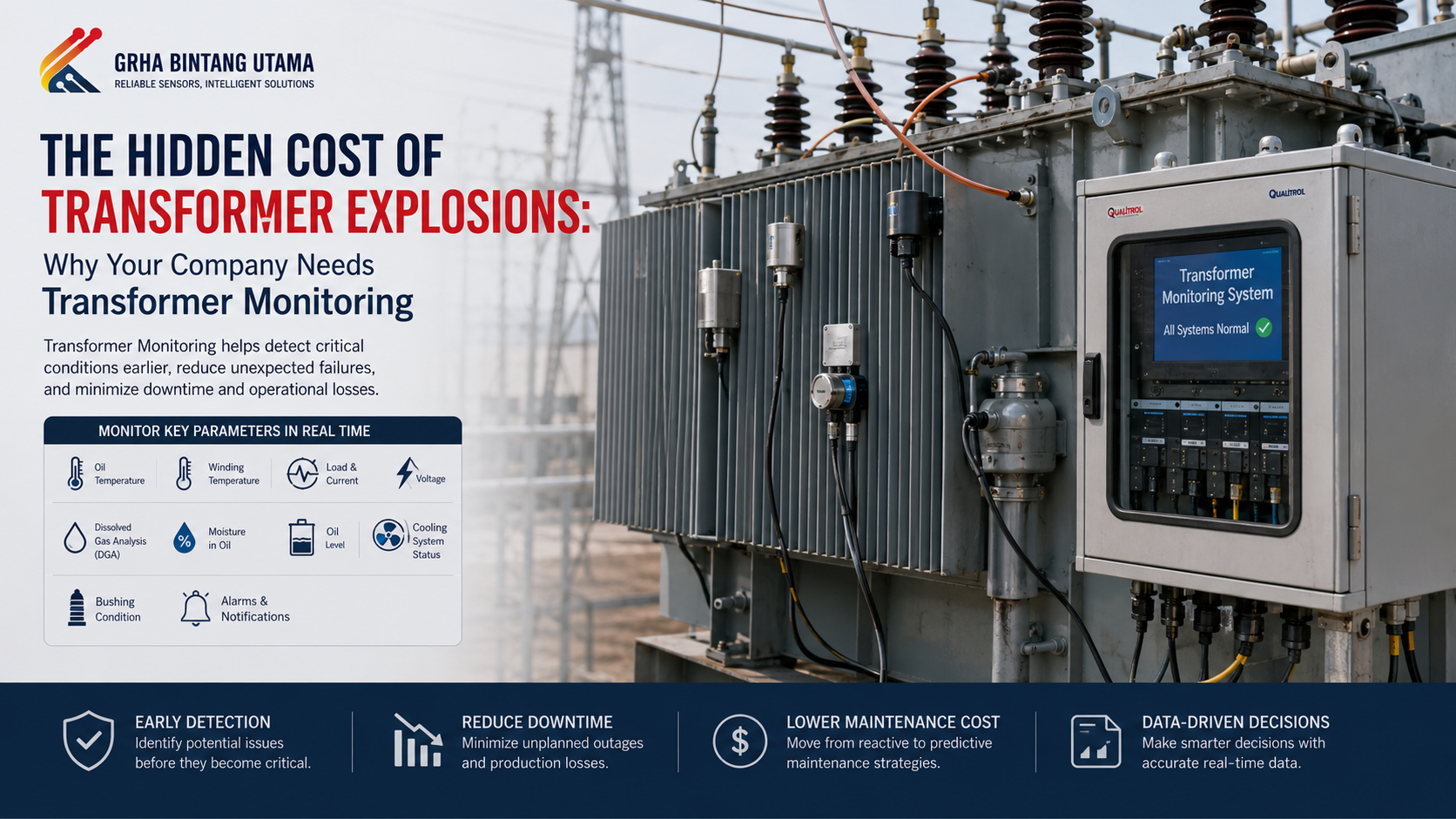
Transformer Monitoring: Prevent Hidden Costs from Transformer Failure and Unplanned Downtime
Author
The Hidden Cost of Transformer Explosions: Why Your Company Needs Transformer Monitoring
In industrial facilities, commercial buildings, data centers, mining operations, manufacturing plants, power generation facilities, and other critical infrastructure, power transformers are among the most important assets within an electrical distribution system.
However, because transformers generally operate continuously with limited direct interaction from operators, their condition can easily be assumed to be normal as long as electricity continues to flow.
The reality can be very different.
Inside a transformer, several conditions may gradually change without being immediately visible from the outside.
Temperature can increase.
Insulating oil characteristics can change.
Certain gases may form due to thermal or electrical activity inside oil-filled transformers.
Electrical loading may increase.
Bushings may deteriorate.
Cooling system performance may decline.
Moisture may influence the insulation system.
When these conditions develop without adequate detection and are not properly addressed, a company may eventually face a serious transformer failure.
The problem is that the financial impact of transformer failure does not stop at the cost of repairing or replacing the transformer itself.
The actual business impact can include production downtime, lost revenue, damage to connected equipment, emergency labor costs, operational disruption, safety risks, delivery delays, and potentially even reputational consequences.
Companies should therefore shift the question from:
“How much will it cost to repair our transformer if it fails?”
to:
“How much could our business lose if a critical transformer suddenly becomes unavailable?”
This is where Transformer Monitoring becomes an important component of modern electrical asset management.
1. A Transformer Is More Than Just Electrical Equipment
The primary function of a transformer is to change voltage levels so electrical energy can be transmitted and distributed according to system requirements.
Within industrial environments, transformers may provide electrical power to critical equipment such as:
- electric motors;
- conveyors;
- pumps;
- compressors;
- servers;
- cooling systems;
- production machinery;
- control systems;
- communication infrastructure;
- safety systems;
- and complete facility electrical networks.
This means that when a main transformer experiences a serious failure, the impact can spread across multiple operational processes.
A damaged production machine may stop one part of a production line.
A failure of the main transformer, however, can potentially affect every system receiving power from that transformer.
For this reason, transformers should be treated as critical electrical assets, not simply as individual components within the power distribution network.
2. What Happens When a Transformer Fails?
Transformer failure can occur in different forms and may have many possible causes.
Problems may develop within the insulation system, windings, bushings, tap changers, transformer oil, cooling systems, electrical connections, or other components.
In oil-filled transformers, certain thermal and electrical conditions can produce gases that dissolve in the insulating oil.
This is one reason why Dissolved Gas Analysis (DGA) is widely used as a diagnostic method for assessing the internal condition of oil-immersed transformers.
DGA can provide information regarding internal activity that may not be visible through external inspection alone.
However, transformer failures do not necessarily occur without any prior indications.
In many situations, changes in operating parameters can develop before a major failure occurs.
The critical question is:
Does your company have the capability to detect those changes?
When condition assessment depends primarily on periodic inspections, anomalies developing between two inspection intervals may not be immediately identified.
Transformer Monitoring helps address this challenge by providing more continuous visibility into asset condition.
3. Hidden Cost No. 1: Transformer Repair or Replacement
The most obvious financial consequence is the direct cost.
If the transformer can still be repaired, the company may need to pay for inspection, troubleshooting, replacement components, specialist services, testing, transportation, and recommissioning.
If the damage is severe, complete transformer replacement may be required.
But the price of the replacement transformer is only one part of the overall financial impact.
Companies may also need to consider:
Mobilization → Installation → Cabling → Testing → Commissioning → Civil Work → Labor → Logistics → Temporary Power → Downtime
For large transformers or units with specialized specifications, procurement and replacement may not be completed quickly.
The more critical the transformer is to company operations, the greater the financial consequences when the asset becomes unavailable.
4. Hidden Cost No. 2: Production Downtime
Production downtime can become one of the largest hidden costs associated with transformer failure.
Imagine a manufacturing or mining facility operating 24 hours a day.
At 2:00 AM, the main transformer experiences a serious fault.
The protection system disconnects the electrical supply.
Production stops.
The maintenance team must determine the source of the problem.
If the transformer cannot be immediately returned to service, the company may require a replacement transformer or temporary power solution.
During this period, the company is not only paying for equipment repairs.
It is also losing productive operating hours.
A simplified calculation might be:
Downtime Loss = Downtime Duration × Production Value per Hour
In reality, however, the total calculation can be significantly more complex.
Downtime can also result in:
- lost production output;
- missed production targets;
- employee overtime;
- emergency generator operation;
- additional fuel consumption;
- distribution delays;
- equipment restart costs;
- product losses;
- and possible material scrap.
As a result, the financial impact of a single electrical incident may become significantly greater than the cost of the damaged equipment itself.
5. Hidden Cost No. 3: Damage to Other Electrical Equipment
An electrical system does not operate as a collection of completely independent assets.
Depending on the nature of the event and the effectiveness of protection systems, abnormal electrical conditions can potentially affect other connected equipment.
These assets may include:
- switchgear;
- cables;
- protection relays;
- electrical panels;
- motors;
- UPS systems;
- control systems;
- and sensitive electronic equipment.
This is why reliability strategies should not treat the transformer as an isolated asset.
A transformer forms part of a larger electrical ecosystem.
Transformer Monitoring can provide another layer of information that helps engineering teams better understand the condition of this critical component within the overall electrical network.
6. Hidden Cost No. 4: Emergency Maintenance
Planned maintenance and emergency maintenance have very different cost structures.
During planned maintenance, companies can determine:
when the work will be performed, which technicians are required, which spare parts must be prepared, when production should be stopped, and how operational impacts will be mitigated.
Emergency maintenance provides far less flexibility.
Technicians may need to work outside normal hours.
Specialists may need to be mobilized immediately.
Parts may require expedited shipping.
Temporary equipment may need to be rented.
Production remains interrupted.
Management needs answers quickly.
The result is a maintenance event that can be significantly more difficult and expensive to manage.
Transformer Monitoring supports a different approach:
Detect changing conditions → Analyze the information → Plan inspection → Schedule maintenance before conditions become more serious.
This is one of the fundamental principles behind condition-based maintenance and predictive maintenance.
7. Hidden Cost No. 5: Safety Risks
When discussing transformer failures, companies should not evaluate financial consequences alone.
Personnel safety is a fundamental consideration.
Certain electrical faults may involve extreme heat, electrical arcing, pressure, fire, or other hazardous conditions.
For this reason, Transformer Monitoring must never be considered a replacement for electrical protection and safety systems.
Protection relays, circuit breakers, fire protection systems, grounding systems, and other safety measures continue to perform their respective functions.
Transformer Monitoring provides an additional layer of condition awareness.
The objective is to help engineering and maintenance teams identify changing asset conditions earlier, allowing appropriate evaluation before an issue potentially develops further.
8. What Is Transformer Monitoring?
Transformer Monitoring is an approach used to observe transformer operating parameters and asset condition using sensors, data acquisition devices, communication infrastructure, analytical software, and monitoring dashboards.
The exact configuration can vary depending on transformer type, asset criticality, transformer capacity, operational requirements, and risk profile.
A typical monitoring workflow can be illustrated as:
TRANSFORMER → SENSORS → DATA ACQUISITION → COMMUNICATION → SERVER → ANALYTICS → DASHBOARD → ALERT → ENGINEER
Sensors measure specific parameters.
Data is collected.
Information is transmitted.
The monitoring platform stores and analyzes the data.
The dashboard displays the condition.
When a parameter meets a predefined alarm condition, the system can generate a notification.
Engineers can then perform further evaluation.
Transformer Monitoring is therefore not simply about installing sensors.
Its real value lies in transforming raw measurements into actionable engineering information.
9. What Parameters Can Transformer Monitoring Measure?
The parameters monitored depend on transformer design, system configuration, and monitoring objectives.
Several important parameters may include:
Oil Temperature
Oil temperature provides information about the thermal condition of the transformer.
Temperature changes should be evaluated together with transformer loading, ambient temperature, cooling system performance, and transformer characteristics.
Winding and Hot-Spot Temperature
Winding temperature is particularly important because transformer insulation is highly influenced by thermal conditions.
Temperature monitoring allows operators to understand how the transformer responds to changing loads.
Load and Current
Current monitoring provides visibility into transformer loading.
This information can be correlated with temperature data to better understand the relationship between electrical load and thermal response.
Voltage
Voltage monitoring provides additional information regarding electrical operating conditions and can form part of the broader electrical performance monitoring strategy.
Dissolved Gas Analysis
For oil-filled transformers, DGA is an important method for detecting internal activity.
Certain gases can develop due to thermal or electrical stress affecting the materials inside a transformer.
IEEE C57.104 provides guidance for interpreting gases generated in mineral-oil-immersed transformers.
Moisture
Moisture within transformer insulation is another important condition parameter.
Water content can affect insulation performance, making moisture assessment relevant to overall transformer condition evaluation.
Oil Level
Abnormal transformer oil levels may indicate conditions that require inspection.
Cooling System Status
Fans and pumps within the cooling system play an important role in maintaining appropriate transformer temperatures.
Cooling system problems can cause temperature to increase even when the transformer does not have an internal electrical fault.
Bushing Condition
Bushings are critical components in high-voltage transformers.
Depending on the monitoring architecture, bushing condition can also be monitored to provide additional information about asset health.
10. Why Is DGA Important in Transformer Monitoring?
Dissolved Gas Analysis is an established diagnostic technique for oil-filled transformers.
When insulating oil or solid insulation materials experience thermal or electrical stress, certain gases may be produced and dissolve in the oil.
The gases evaluated may include:
- Hydrogen (H₂);
- Methane (CH₄);
- Ethane (C₂H₆);
- Ethylene (C₂H₄);
- Acetylene (C₂H₂);
- Carbon Monoxide (CO);
- Carbon Dioxide (CO₂).
Gas concentration, patterns, ratios, and especially trends can provide valuable information for engineering diagnosis.
The importance of DGA therefore does not come from observing a single number alone.
Trend over time matters.
If the concentration of a particular gas begins increasing significantly, engineers may conduct additional investigation even if the transformer appears externally normal.
Transformer Monitoring that incorporates online DGA can increase visibility into how these conditions develop over time.
11. Moving from Preventive Maintenance to Predictive Maintenance
Traditional maintenance strategies frequently rely on scheduled intervals.
For example:
Inspection every six months.
Specific electrical tests every twelve months.
Time-based maintenance remains valuable and should not simply be eliminated.
However, it has an important limitation.
What happens if a problem begins developing one week after an inspection has been completed?
Unless another protection or monitoring system detects the issue, the company may not identify the change until the next scheduled inspection—or until the condition becomes more serious.
Condition monitoring adds another dimension.
With more continuous condition data, organizations can begin combining:
Time-Based Maintenance + Condition-Based Maintenance + Predictive Maintenance
Historical information allows engineers to identify trends.
For example:
Transformer temperature gradually increases.
Specific dissolved gases show an upward trend.
Electrical load increases.
Cooling system performance begins declining.
One parameter alone may not provide sufficient information for a decision.
When multiple parameters are evaluated together, however, engineers gain a much richer understanding of transformer behavior.
12. Transformer Monitoring Dashboard: Turning Sensor Data into Information
Installing numerous sensors without an effective visualization system can simply create large volumes of data.
This is why an effective Transformer Monitoring solution requires a dashboard.
A monitoring dashboard may display:
- transformer status;
- oil temperature;
- winding temperature;
- current;
- voltage;
- load percentage;
- DGA trends;
- moisture;
- cooling system status;
- historical graphs;
- alarm history;
- event logs;
- sensor health;
- communication status.
The objective is to allow engineers to understand asset condition without manually examining millions of raw data points.
Conceptually, the transformation is:
SENSOR DATA → INFORMATION → INSIGHT → ACTION
The dashboard may also classify monitoring conditions as:
NORMAL
WARNING
CRITICAL
However, alarm thresholds should never be selected arbitrarily.
Thresholds should consider equipment specifications, engineering assessments, applicable standards, OEM recommendations, historical baseline conditions, and operational requirements.
13. Early Warning: The Real Value of Transformer Monitoring
One of the most important objectives of Transformer Monitoring is improving situational awareness.
When monitored parameters indicate abnormal conditions, the system may generate notifications through:
- monitoring dashboards;
- email;
- SMS;
- mobile applications;
- control room systems;
- or integration with other monitoring platforms.
It is important to emphasize that:
Transformer Monitoring cannot guarantee that a transformer will never fail.
Its purpose is to increase visibility into transformer condition and changing parameters so engineering teams can make better-informed decisions.
Early detection provides something extremely valuable:
Time.
Time to inspect.
Time to analyze.
Time to prepare spare parts.
Time to plan a shutdown.
Time to perform maintenance.
Time to avoid emergency decisions.
For critical electrical assets, additional decision-making time can have substantial operational and financial value.
14. Integrating Transformer Monitoring with Electrical Monitoring
The value of Transformer Monitoring can increase further when transformer condition data is integrated with a broader electrical monitoring system.
Organizations can combine information from:
Transformer + Power Meter + Protection Relay + Switchgear + Environmental Sensors + Energy Monitoring System
This provides a more comprehensive picture of electrical infrastructure performance.
Consider a transformer experiencing increasing temperature.
What is causing it?
An internal fault?
Increasing electrical load?
High ambient temperature?
A cooling fan that has stopped operating?
By combining multiple data sources, engineers can analyze transformer conditions with greater operational context.
This is particularly important because many transformer parameters influence one another.
A higher load can increase temperature.
Environmental conditions can influence thermal performance.
Cooling system degradation can change the relationship between load and temperature.
Integrated monitoring therefore enables engineers to move beyond isolated measurements toward a more complete understanding of asset behavior.
15. Which Industries Need Transformer Monitoring?
Transformer Monitoring is particularly relevant for organizations operating transformers with high operational criticality.
Mining
Mining facilities depend heavily on electrical power for crushers, conveyors, processing plants, pumping systems, ventilation, workshops, and supporting infrastructure.
Unexpected transformer failure can therefore disrupt significant portions of mining operations.
Manufacturing
Production lines depend on stable electrical supply.
A transformer failure may stop machinery, interrupt production schedules, and create downstream delivery problems.
Data Centers
Electrical reliability is one of the most important operational requirements for data centers.
Transformer condition therefore becomes part of the broader infrastructure reliability strategy.
Commercial and High-Rise Buildings
Transformers may supply HVAC systems, elevators, lighting, fire protection systems, communication equipment, and other building infrastructure.
Oil and Gas
Electrical reliability supports process equipment, utilities, instrumentation, safety systems, and supporting facilities.
Power Generation and Substations
Transformers are fundamental assets within electricity generation, transmission, and distribution networks.
Transportation Infrastructure
Airports, ports, railway facilities, terminals, and other transportation infrastructure require reliable electrical systems to maintain operations.
16. Building the Business Case for Transformer Monitoring
Management may initially ask:
“How much does a Transformer Monitoring system cost?”
That is a valid question.
However, another question is equally important:
“How much could we lose if our critical transformer fails without sufficient warning?”
A simplified business case may consider:
Potential Loss = Repair Cost + Replacement Cost + Downtime Loss + Production Loss + Emergency Cost + Secondary Damage + Logistics Cost
This can then be compared with:
Monitoring Investment = Sensors + Installation + Communication + Software + Integration + Maintenance
This approach shifts the investment discussion away from equipment price alone.
Transformer Monitoring can instead be evaluated in terms of risk reduction, asset reliability, maintenance efficiency, and operational continuity.
Consider a transformer supporting a production process worth a significant amount of revenue every hour.
In such an environment, preventing or reducing even a relatively short period of unplanned downtime may create substantial economic value.
17. Transformer Monitoring Does Not Replace Engineers
Like other condition-monitoring technologies, Transformer Monitoring does not replace professional engineering expertise.
When the system generates a warning, engineers still need to evaluate the information.
The process may include:
- verifying sensor data;
- comparing measurements with other parameters;
- reviewing historical trends;
- examining the transformer load profile;
- evaluating temperature behavior;
- performing oil sampling when required;
- conducting physical inspections;
- performing electrical testing;
- consulting the OEM or transformer specialists;
- determining appropriate maintenance actions.
The relationship can therefore be summarized as:
Monitoring provides data.
Engineers provide interpretation.
Management determines actions based on operational requirements and risk.
The strongest transformer asset management strategy combines reliable monitoring technology with experienced engineering judgment.
18. Why PT Grha Bintang Utama Supports Data-Driven Transformer Monitoring
Digital transformation in maintenance is not simply about replacing paper reports with computer dashboards.
A deeper transformation occurs when physical assets continuously generate condition data that can support operational decisions.
In the context of transformers, PT Grha Bintang Utama recognizes Transformer Monitoring as an important component in developing a more measurable, condition-based approach to electrical asset management.
Sensors become the digital eyes and ears of engineering teams.
Data Acquisition Systems collect information.
Communication networks transfer the data.
Databases preserve historical records.
Analytics help identify changes.
Dashboards simplify complex information.
Alerts draw attention to abnormal conditions.
Engineers evaluate the results and determine appropriate actions.
Together, these components form an integrated monitoring ecosystem:
SENSE → CONNECT → MONITOR → ANALYZE → ALERT → ACT
The objective is not simply to install technology.
The objective is to transform electrical asset condition into information that can support maintenance planning, risk management, and operational reliability.
19. From Hidden Costs to More Measurable Transformer Risk
When a transformer experiences a serious failure, the consequences can spread throughout the organization.
Production stops.
Maintenance teams enter emergency response mode.
Management must make rapid decisions.
Vendors may need to be mobilized immediately.
Replacement equipment must be located.
Temporary power may be required.
Customers may experience delays.
Operational targets may be affected.
These are the hidden costs of transformer failure.
Companies cannot eliminate every possible electrical risk.
What they can do is improve visibility into the condition of critical assets.
The earlier an abnormal trend can be identified, the more opportunity engineering teams may have to investigate before the condition develops further.
This is an important distinction.
The value of Transformer Monitoring does not come from predicting every failure with absolute certainty.
Its value comes from improving condition visibility, trend awareness, early detection, and engineering decision support.
20. Transformer Monitoring as Part of a Smarter Maintenance Strategy
Modern maintenance is increasingly moving toward data-driven decision-making.
Instead of asking only:
“When was this transformer last inspected?”
Companies can also begin asking:
“What has changed in this transformer's condition since the last inspection?”
That difference is fundamental.
The first question focuses on time.
The second focuses on condition.
By combining scheduled inspections with online or continuous monitoring, companies can develop a more comprehensive maintenance strategy.
A practical approach may combine:
Preventive Maintenance
for routine inspection and scheduled maintenance activities.
Condition-Based Maintenance
for maintenance decisions based on actual asset condition.
Predictive Maintenance
for identifying trends and estimating when intervention may become necessary.
Protection Systems
for responding to electrical faults and abnormal conditions according to system design.
Each approach serves a different purpose.
Together, they can support a stronger transformer reliability strategy.
Conclusion: Do Not Wait for Transformer Failure to Start Monitoring
Transformers are among the most strategic assets in a company's electrical infrastructure.
When a transformer experiences a serious failure, the financial consequences extend far beyond repair or replacement costs.
The total impact may include downtime, production losses, emergency maintenance, secondary equipment damage, operational delays, and safety risks.
This is why Transformer Monitoring is becoming increasingly relevant to modern electrical asset management.
By combining transformer sensors, Data Acquisition Systems, communication networks, databases, analytics, and monitoring dashboards, companies can gain greater visibility into transformer operating conditions.
Parameters such as temperature, load, current, voltage, moisture, cooling system status, and dissolved gases in applicable oil-filled transformers can provide important information about asset behavior.
Historical monitoring data also allows companies to examine trends rather than relying only on a snapshot of transformer condition at a particular moment.
The fundamental principle is simple:
Do not wait for failure to discover that a problem has been developing.
Develop the capability to identify changing conditions earlier.
Transformer Monitoring can help companies move from a predominantly reactive maintenance approach toward asset management that is more predictive, condition-based, data-driven, and measurable.
For mining operations, manufacturing facilities, data centers, commercial buildings, power facilities, and other critical infrastructure, the most important question is no longer whether transformers require attention.
The more important question is:
How quickly can your company identify when transformer conditions begin to change?
Because for critical electrical assets, additional hours of early warning and preparation can be significantly more valuable than hours of unexpected downtime.
References & Source URLs
1. IEEE – IEEE C57.104-2019: Guide for the Interpretation of Gases Generated in Mineral Oil-Immersed Transformers
https://standards.ieee.org/ieee/C57.104/7476/
2. IEEE Technology Navigator – Dissolved Gas Analysis
https://technav.ieee.org/topic/dissolved-gas-analysis/
3. IEEE Technology Navigator – Liquid-Immersed Power Transformers
https://technav.ieee.org/topic/liquid-immersed-power-transformers/
4. IEEE Xplore – Real-Time Condition Monitoring of Power Transformers Using IoT and Dissolved Gas Analysis
https://ieeexplore.ieee.org/document/10143439/
5. IEEE PES Transformers Committee – Dissolved Gas Analysis in Transformer Oil: Methods, Trending & Assessment
https://grouper.ieee.org/groups/transformers/meetings/f2006_montreal/Documents/F06-MtgPkg.pdf
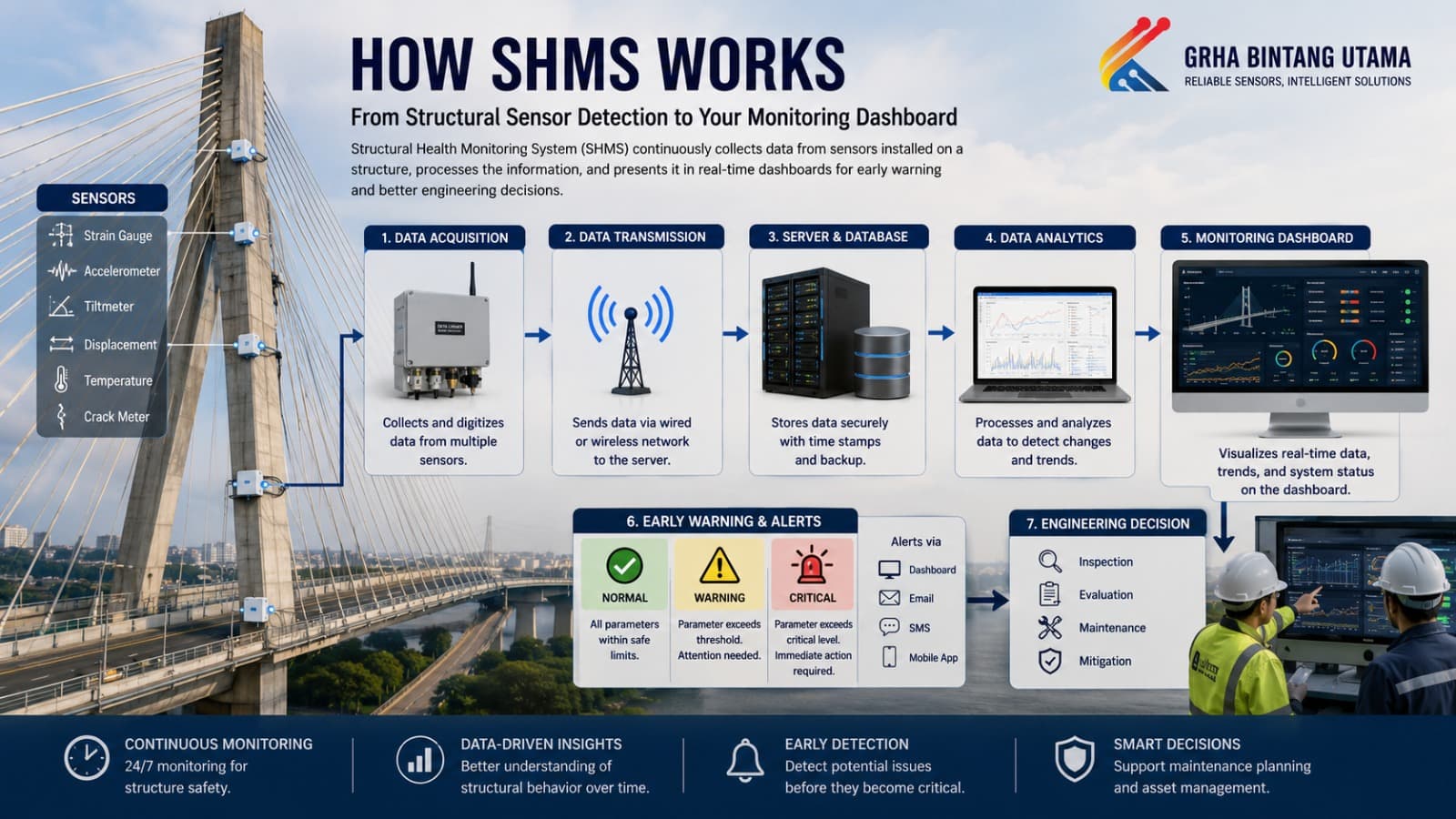
Infographic: How SHMS Works from Structural Sensor Detection to a Real-Time Monitoring Dashboard
Read More
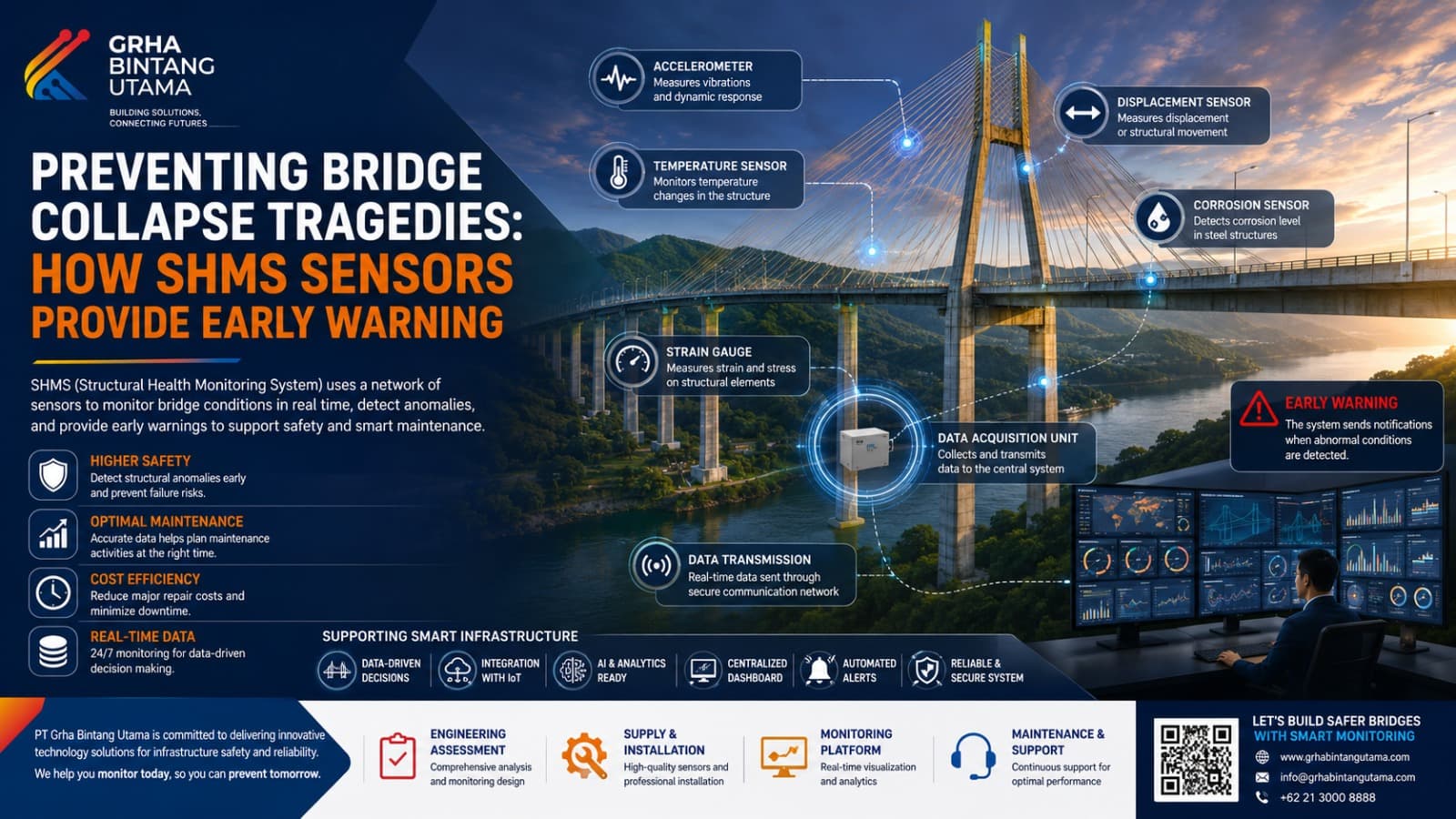
Preventing Bridge Collapse Tragedies: How SHMS Sensors Provide Early Warning
Read More
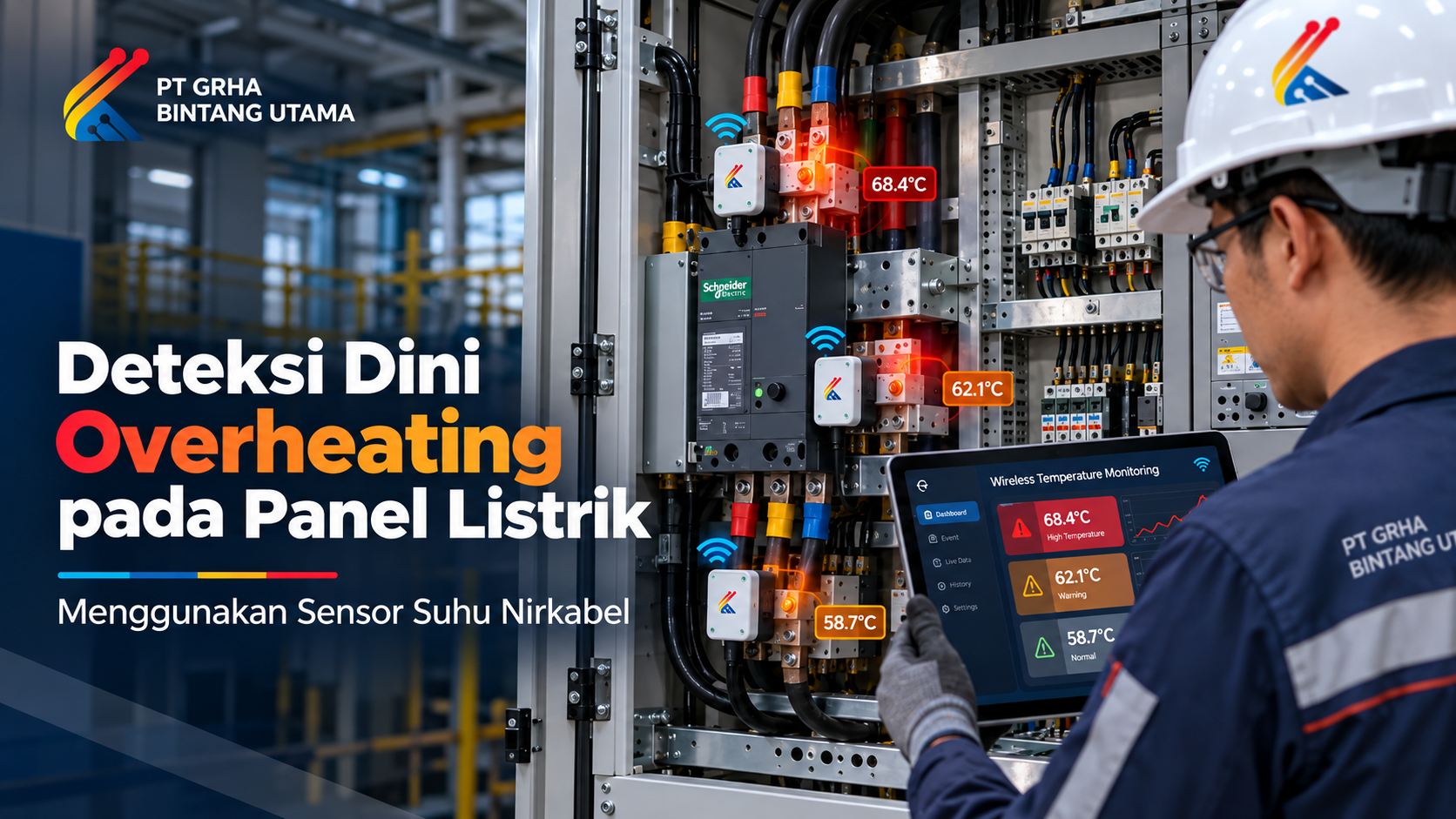
Early Detection of Electrical Panel Overheating Using Wireless Temperature Sensors for Plant Safety.
Read More

Jakarta Selatan, [email protected] 0812-1146-0008