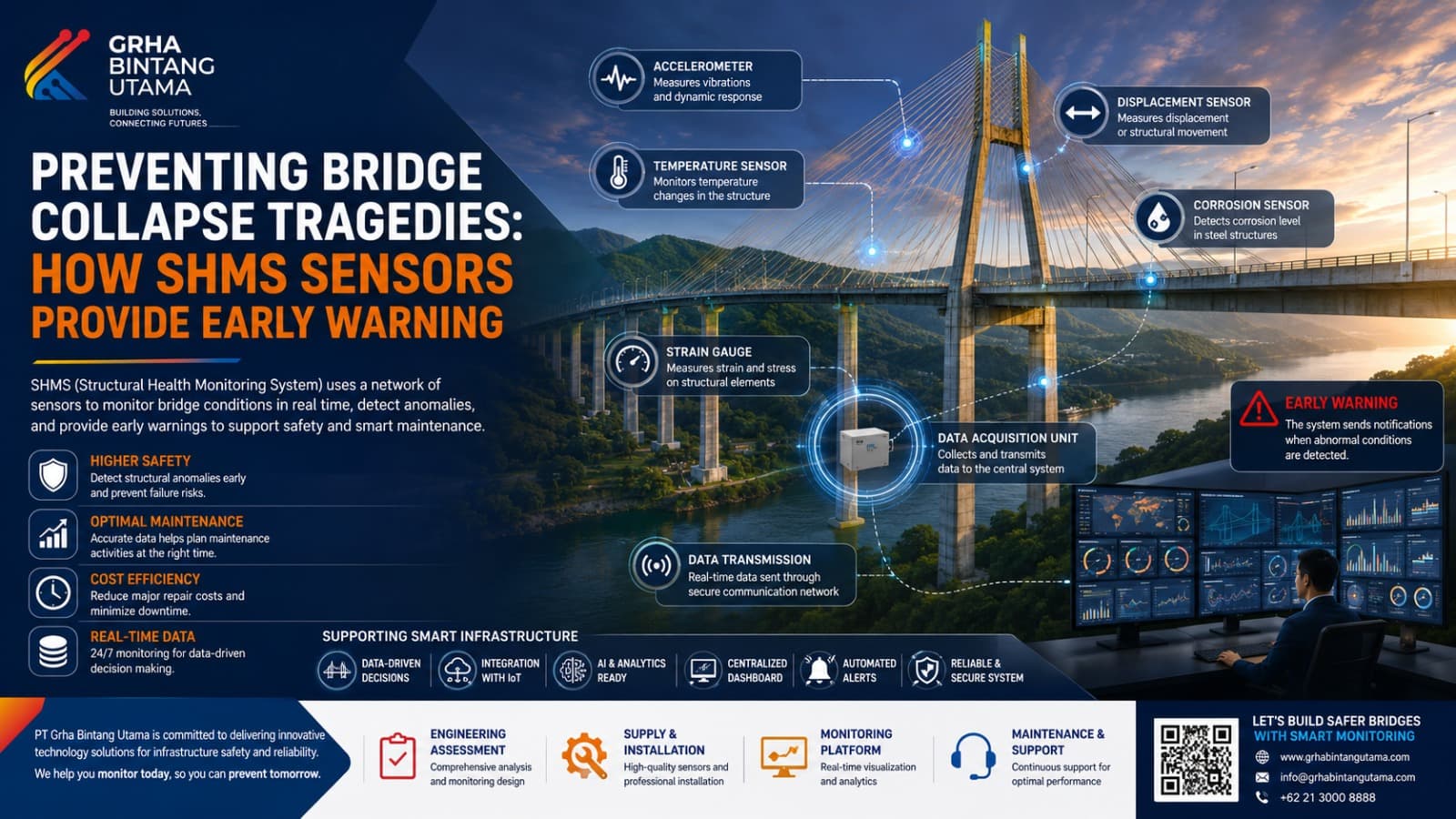
Preventing Bridge Collapse Tragedies: How SHMS Sensors Provide Early Warning
Author
Preventing Bridge Collapse Tragedies: How SHMS Sensors Provide Early Warning
Bridges are among the most critical infrastructure assets supporting human mobility, logistics distribution, industrial operations, and economic activities. Every day, bridge structures are exposed to various loads and environmental conditions, including heavy vehicles, temperature fluctuations, vibration, wind, corrosion, material fatigue, ground movement, and extreme events.
The challenge is that structural deterioration does not always appear suddenly or remain visible to the human eye. Small cracks, abnormal strain, displacement, changes in vibration characteristics, corrosion, or gradual degradation may develop over time before becoming a serious structural problem.
For this reason, visual and periodic inspections remain essential, but they can be strengthened through the implementation of Bridge SHMS Sensors as part of a Structural Health Monitoring System (SHMS).
The U.S. Federal Highway Administration (FHWA) has documented the use of parameters such as load, strain, temperature, and other measurements for structural health monitoring. Continuous monitoring also offers the potential to provide early warning of serious structural deterioration. FHWA — Structural Health Monitoring of Bridge Structures
What Are Bridge SHMS Sensors?
A Structural Health Monitoring System (SHMS) is a technology-based system designed to continuously or periodically monitor the physical condition and structural behavior of infrastructure.
For bridge applications, multiple sensors can be installed at strategic locations based on engineering analysis. These sensors collect structural response data, which is transmitted to a data acquisition system and processed through monitoring software.
A modern SHMS is not limited to collecting information. The system can compare measured parameters against predetermined baseline values or thresholds. When unusual changes occur, the system can generate notifications or early warnings for engineers and infrastructure operators.
Research on bridge health monitoring has demonstrated that warning systems can use single or multiple threshold levels to identify potentially abnormal structural conditions. MDPI — Development of Structural Health Monitoring for Bridges
Why Is Real-Time Bridge Monitoring Important?
Periodic inspections provide valuable information about bridge conditions at the time an inspection is performed. However, bridges continue to experience traffic loads and environmental influences between inspection periods.
This is where Bridge SHMS Sensors provide significant value.
An SHMS can collect structural data continuously or at predefined intervals, allowing engineers to understand how the bridge responds under actual operating conditions.
According to FHWA, without permanent instrumentation and continuous data acquisition methods, quantitatively measuring structural responses to extreme events can be challenging.
Continuous monitoring therefore provides infrastructure owners with additional information that can support decisions regarding inspection, maintenance, and further structural assessment.
What Parameters Can SHMS Monitor?
The configuration of an SHMS should be determined according to the bridge design, structural characteristics, environmental conditions, risks, and monitoring objectives.
Not every bridge requires the same sensors. Depending on project requirements, several important parameters may be monitored.
1. Strain
Strain sensors measure deformation or strain occurring within structural elements.
This information can help engineers understand how bridge components respond to traffic loads and other forces. Significant changes in strain patterns may indicate conditions that require further engineering evaluation.
2. Vibration and Acceleration
Accelerometers are commonly used to measure the dynamic response of structures.
Heavy vehicles, wind, earthquakes, and other activities can cause structural vibration. By analyzing vibration characteristics, engineers can evaluate changes in the dynamic behavior of a bridge.
Structural health monitoring research includes parameters such as strain, acceleration, and corrosion as important measurements for structural condition assessment.
3. Displacement
Displacement sensors can be used to measure movement or changes in the position of structural components.
Abnormal displacement may provide valuable information for evaluating structural performance. Various displacement measurement technologies have been developed for long-term monitoring of bridges and other civil infrastructure.
4. Temperature
Temperature changes cause materials to expand and contract.
For this reason, temperature measurements are important when interpreting structural monitoring data. They can help engineers differentiate normal environmental responses from changes that may require additional structural evaluation.
5. Corrosion and Environmental Conditions
For certain structures, SHMS can also monitor environmental parameters and conditions associated with corrosion.
Corrosion is a major concern for steel structures and reinforced concrete because gradual deterioration can affect the long-term performance of structural components.
Monitoring these conditions provides additional data for maintenance planning and infrastructure asset management.
How Does SHMS Provide Early Warning?
A simplified SHMS architecture can be described as:
Sensors → Data Acquisition → Communication Network → Data Processing → Analysis → Dashboard → Early Warning
First, sensors measure relevant structural parameters.
The measurements are transmitted to a data acquisition system and subsequently processed by monitoring software. The system can then compare the collected information against established baseline conditions and engineering thresholds.
For example, an SHMS may be configured with several monitoring levels:
NORMAL — Parameters remain within established operating limits.
WARNING — A change or anomaly has been identified and requires attention or further evaluation.
CRITICAL — A parameter exceeds an established threshold and requires a rapid response according to the applicable safety procedure.
In this sense, an SHMS can function like the digital nervous system of a bridge. Sensors collect information from different parts of the structure, the monitoring platform analyzes the information, and operators receive alerts when abnormal conditions are identified.
However, an SHMS warning should not automatically be interpreted as confirmation that a bridge is about to collapse.
The warning serves as a decision-support mechanism, helping engineers determine whether additional inspection, engineering assessment, operational restrictions, or other mitigation measures are required.
Learning from Bridge Collapse Tragedies
The importance of structural monitoring has received increased attention following major infrastructure failures.
One widely studied example is the collapse of the I-35W Bridge in Minneapolis on August 1, 2007, which resulted in 13 fatalities.
FHWA subsequently documented the development of remote structural monitoring for the replacement bridge. The system demonstrated how permanent instrumentation and remote monitoring can provide valuable information about structural conditions and responses. FHWA — Structural Health Monitoring of the I-35W Replacement Bridge
The lesson is not that SHMS technology can guarantee that structural failures will never occur.
Instead, its value lies in providing objective and continuous data so that changes in structural behavior can potentially be identified earlier and infrastructure managers can make better-informed decisions.
From Preventive Maintenance to Condition-Based Maintenance
Traditional bridge management commonly relies on scheduled inspections and preventive maintenance.
The implementation of Bridge SHMS Sensors creates an opportunity to move toward a more data-driven approach known as condition-based maintenance.
Instead of relying solely on predetermined maintenance intervals, infrastructure operators can use actual structural data to help identify areas requiring additional attention.
SHMS can therefore support:
- Early identification of structural anomalies
- Prioritization of bridge inspections
- Preventive maintenance planning
- Historical structural data collection
- Analysis of responses to specific events
- Asset lifecycle management
- Data-driven engineering decisions
FHWA has also researched the integration of Structural Health Monitoring data with other bridge evaluation methods to improve the accuracy and reliability of structural assessments. FHWA — Integration of SHM Data for Bridge Evaluation
From Structural Monitoring to Smart Infrastructure
The development of digital technologies is transforming traditional SHMS into a more sophisticated infrastructure monitoring ecosystem.
Modern systems can potentially integrate:
- Internet of Things (IoT)
- Artificial Intelligence
- Machine Learning
- Computer Vision
- Cloud Platforms
- Digital Twin
- Automated Alert Systems
- Centralized Monitoring Dashboards
Through a centralized dashboard, infrastructure managers can monitor information such as strain trends, vibration, displacement, temperature, sensor status, alarm history, and historical structural behavior.
This approach provides greater situational awareness and enables infrastructure owners to better understand how their assets behave over time.
PT Grha Bintang Utama and Structural Monitoring Solutions
As a company providing technology and infrastructure solutions, PT Grha Bintang Utama can support the implementation of structural monitoring solutions tailored to project requirements and site conditions.
A proper SHMS implementation should begin with a comprehensive understanding of the structure and monitoring objectives.
The implementation process may include:
Site Assessment → Engineering Analysis → Sensor Selection → System Design → Installation → Data Acquisition → Dashboard Integration → Monitoring & Maintenance
Each infrastructure project has different structural characteristics and operational requirements.
Therefore, an effective SHMS should not simply focus on installing as many sensors as possible.
The more important question is:
What structural information is required to support safety and maintenance decisions?
By starting with this objective, engineers can determine appropriate sensor types, locations, communication infrastructure, monitoring thresholds, and data visualization requirements.
The Future of Bridge Safety Is Data-Driven
Infrastructure management is gradually shifting from reactive maintenance toward predictive and preventive strategies.
Instead of waiting until damage becomes clearly visible, infrastructure owners can use structural monitoring data to understand changes in asset behavior over time.
Bridge SHMS Sensors can play an important role in this transformation.
Continuous structural data can help asset owners establish historical trends, identify abnormal behavior, prioritize inspection activities, and support maintenance decisions.
When combined with engineering expertise and regular physical inspection, SHMS can become a powerful component of a comprehensive bridge safety strategy.
Conclusion
Bridge deterioration can develop gradually, and not every structural change can be identified through visual inspection alone.
For this reason, Bridge SHMS Sensors can become an important part of infrastructure safety and risk mitigation strategies.
By monitoring parameters such as strain, displacement, acceleration, temperature, corrosion-related conditions, and other relevant measurements, SHMS provides continuous information regarding structural behavior.
When measured data exceeds established thresholds, the system can generate an early warning so engineers and infrastructure managers have an opportunity to investigate the condition and determine the appropriate response.
SHMS should not replace engineers or physical bridge inspections. Instead, it should operate as a decision-support system that strengthens inspection, preventive maintenance, risk mitigation, and infrastructure asset management.
With this approach, bridge management can evolve from simply repairing infrastructure after deterioration occurs toward a more proactive strategy:
Detect earlier. Understand better. Mitigate faster.
That is the fundamental value of Structural Health Monitoring in building safer, smarter, and more resilient infrastructure.
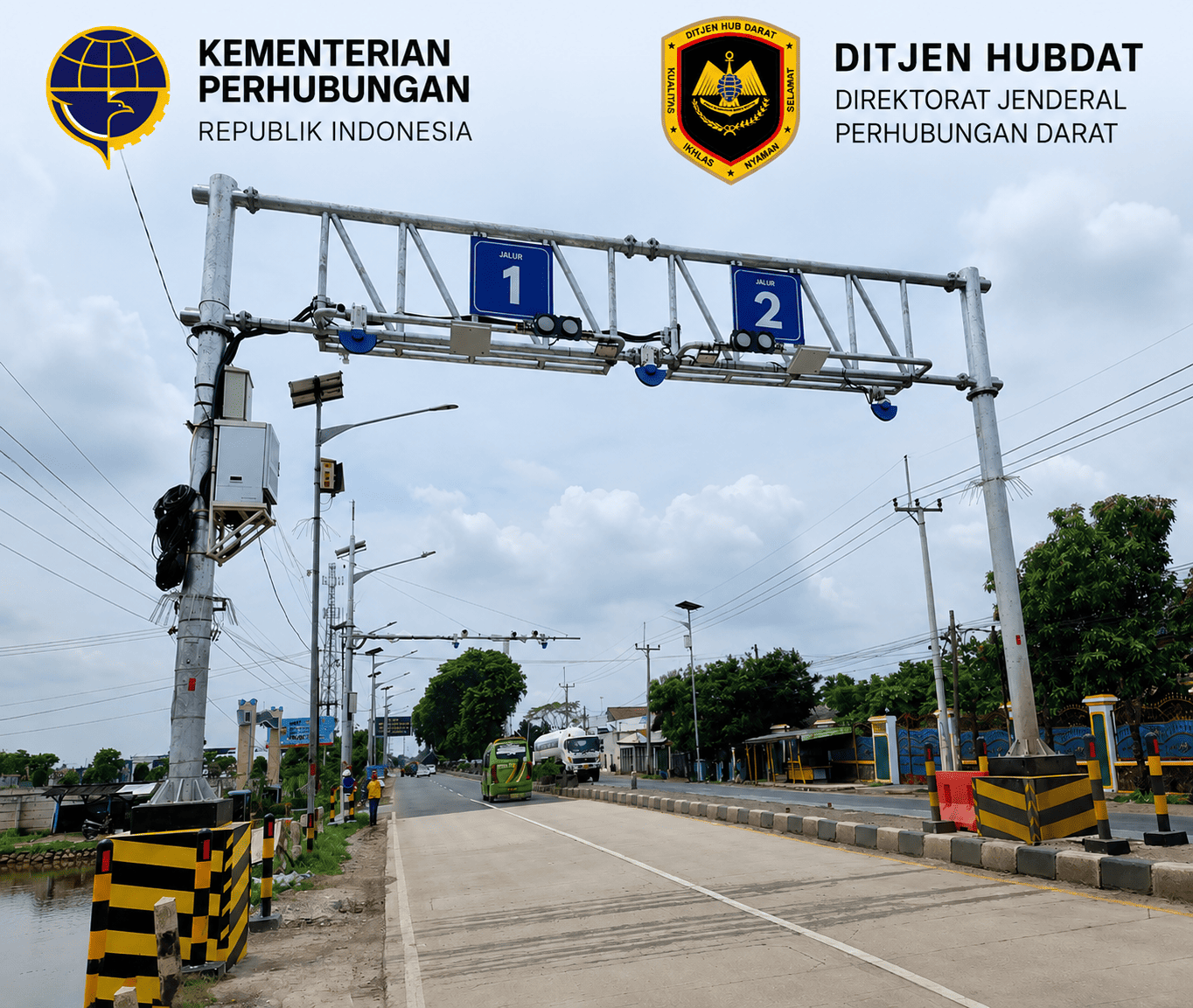
How WIM Technology Supports ODOL Vehicle Monitoring Across Indonesia
Read More
How Strain Gauge Sensors Work in High-Performance WIM Systems

Read More
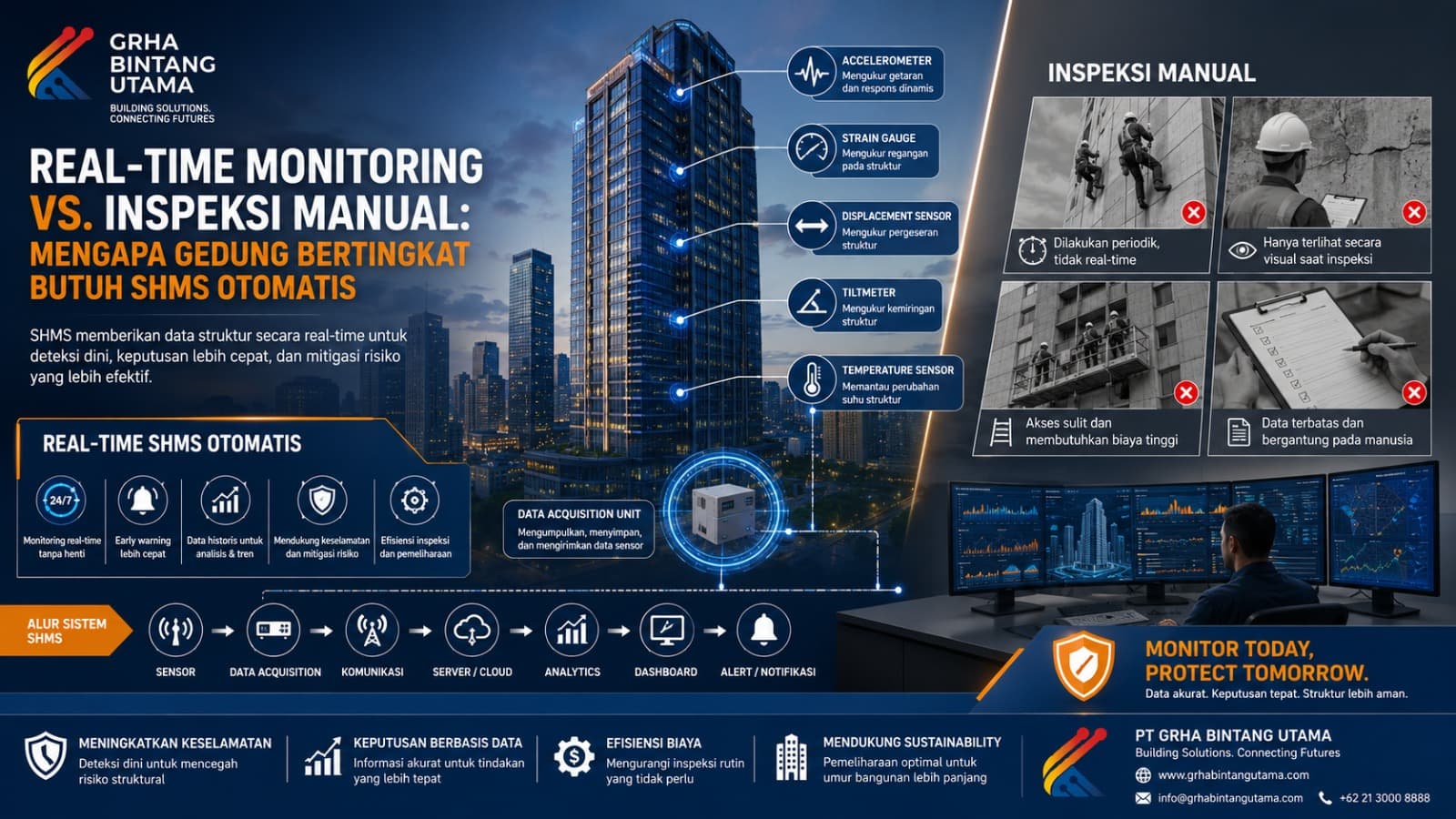
Real-Time Monitoring vs Manual Inspection: Why High-Rise Buildings Need Automated SHMS
Read More

Jakarta Selatan, [email protected] 0812-1146-0008