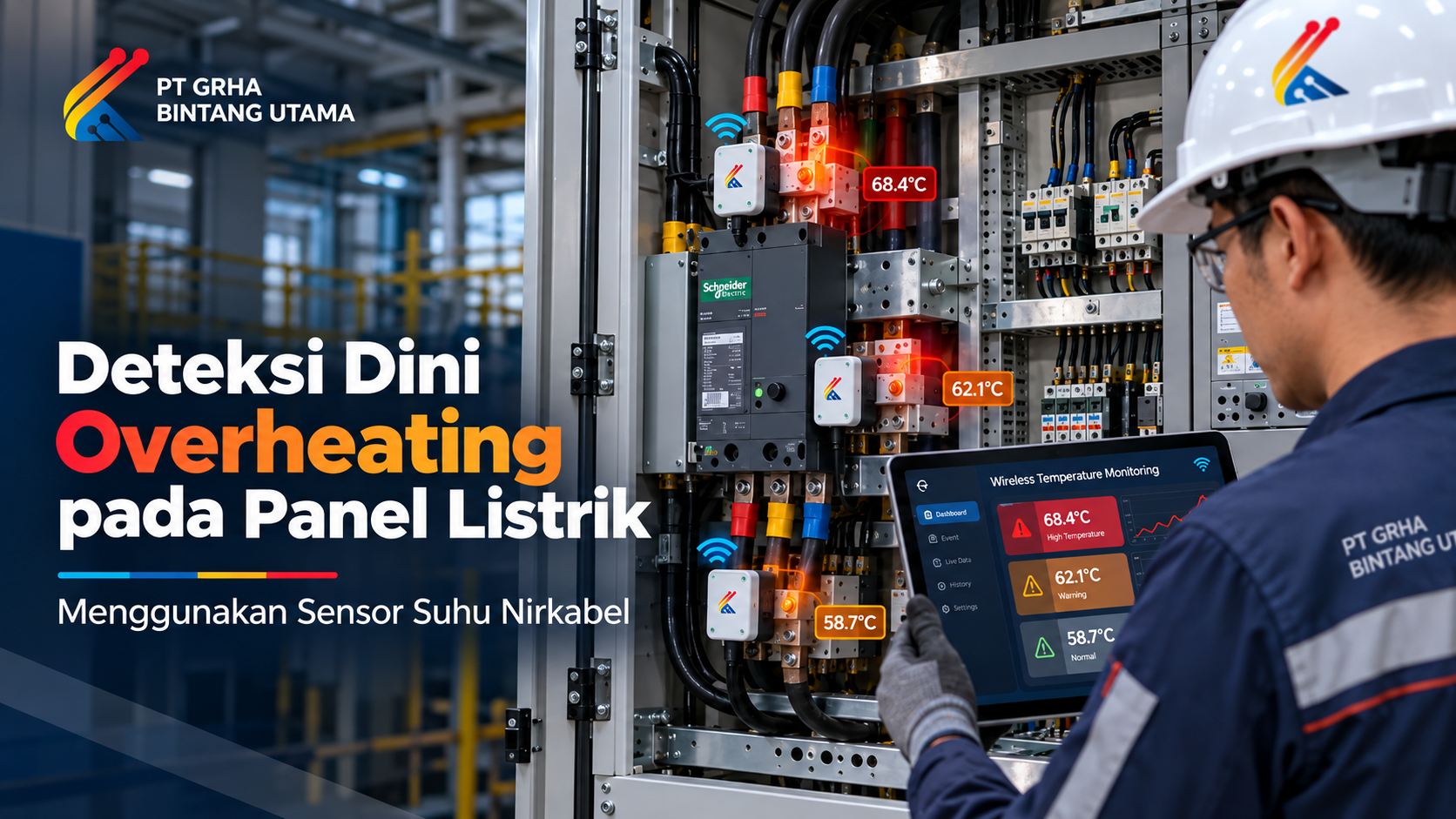
Early Detection of Electrical Panel Overheating Using Wireless Temperature Sensors for Plant Safety.
Author
Early Detection of Electrical Panel Overheating Using Wireless Temperature Sensors
Electrical panels are critical components of power distribution systems in industrial plants, commercial buildings, mining facilities, data centers, warehouses, and other infrastructure. Almost every operational process depends on electrical panels to distribute power to machinery, motors, control systems, lighting, and other equipment.
Because of this important role, abnormal conditions inside an electrical panel should be detected as early as possible. One of the conditions that deserves particular attention is electrical panel overheating.
Excessive temperature may develop gradually and may not be immediately visible to operators. By implementing a wireless temperature sensor for electrical panels, temperature conditions at critical points can be continuously monitored, giving maintenance personnel better visibility into potential problems before they develop into equipment failures.
Fluke explains that abnormal heating in electrical systems can be associated with excessive resistance or excessive current flow. Loose connections, undersized conductors, and overloaded circuits can generate unwanted heat that may eventually damage electrical equipment.
Why Electrical Panel Overheating Matters
Heat is naturally generated when electrical equipment operates. However, abnormal or continuously increasing temperature may indicate that something is wrong.
One common example is a deteriorating electrical connection. As contact resistance increases, electrical energy passing through the connection may generate additional heat.
Other potential causes include:
-
Loose cable or terminal connections.
-
Electrical overload.
-
Phase imbalance.
-
High-resistance connections.
-
Poor ventilation.
-
Dust accumulation.
-
High ambient temperature.
-
Deteriorating electrical components.
-
Harmonic currents.
-
Excessive humidity or environmental contamination.
If these conditions remain undetected, they may contribute to insulation degradation, breaker failure, cable damage, unexpected shutdowns, production downtime, or other electrical hazards.
NFPA 70B emphasizes the importance of maintaining electrical equipment through structured inspection, testing, servicing, documentation, and corrective actions. A well-managed electrical maintenance program supports both system safety and reliability.
What Is a Wireless Temperature Sensor for Electrical Panels?
A wireless temperature sensor for electrical panels is designed to measure temperature at selected locations and transmit the data without requiring a conventional communication cable from every sensor.
Depending on the application, sensors may monitor locations such as:
-
busbar connections;
-
cable terminals;
-
circuit breakers;
-
switchgear;
-
electrical joints;
-
cabinet ambient temperature;
-
transformer connections.
The measurements can then be transmitted to a gateway, controller, PLC, server, cloud platform, or centralized monitoring system.
This approach provides an important advantage compared with periodic inspections because operators can continuously observe temperature conditions rather than relying only on measurements collected during scheduled maintenance.
Banner Engineering describes a control-panel monitoring application in which temperature and humidity sensors are connected to wireless nodes. Environmental information is transmitted to a wireless controller and can then be forwarded for remote monitoring. Alerts can also be generated when conditions exceed predefined parameters.
How Does Wireless Temperature Monitoring Work?
A typical system consists of several components.
1. Temperature Sensors
Sensors measure temperature at the selected monitoring points.
Depending on the technology and application, they may measure the temperature of a connection, electrical component, cabinet surface, or ambient environment.
2. Wireless Communication
Sensor information is transmitted wirelessly to a receiver or gateway.
This can simplify installations where large numbers of electrical panels need to be monitored because additional communication cabling can be reduced.
3. Gateway or Controller
The gateway collects information from multiple sensors.
It can then send this information to other systems such as a PLC, SCADA system, local server, cloud platform, or industrial dashboard.
4. Monitoring Dashboard
The monitoring platform can display information such as:
-
current temperature;
-
historical temperature;
-
individual sensor status;
-
temperature trend;
-
alarms;
-
abnormal conditions.
5. Alarm and Notification System
If a temperature measurement exceeds a defined threshold or demonstrates an abnormal trend, the system can notify operators or maintenance personnel.
Schneider Electric describes continuous thermal monitoring solutions that provide real-time temperature information, historical trend analysis, and alarms or notifications for abnormal thermal conditions. Its monitoring applications can identify exceptional conditions related to overloads or faulty power connections in cables, busbars, breakers, and transformers.
Continuous Monitoring Versus Periodic Inspection
Traditional maintenance commonly includes scheduled visual inspections and infrared thermography.
These remain valuable maintenance methods. Thermal imaging, for example, enables technicians to identify temperature differences between comparable electrical components.
However, periodic inspection only provides information about conditions during the inspection period.
A problem that develops between two scheduled inspections may therefore remain unnoticed for a period of time.
Continuous monitoring provides another layer of information by collecting temperature data throughout equipment operation.
Rather than seeing only one measurement, maintenance teams can analyze how temperature changes over hours, days, weeks, or months.
This trend information can significantly improve condition-based maintenance decisions.
Supporting Predictive Maintenance
Continuous temperature monitoring can also support the transition from preventive maintenance toward predictive maintenance.
Preventive maintenance is generally performed according to predefined schedules.
Predictive maintenance, on the other hand, uses information about actual equipment condition to help determine when intervention may be necessary.
Imagine that a connection normally operates at approximately 40°C.
Historical data then records the following pattern:
-
40°C under normal conditions;
-
45°C several weeks later;
-
49°C during the next monitoring period;
-
54°C afterward.
Even before a failure occurs, the increasing trend may justify further investigation.
The maintenance team can examine electrical loading, connection torque, component condition, ventilation, current balance, or other factors that could be responsible for the rising temperature.
In this way, maintenance can become more proactive and data driven.
Advantages of Wireless Monitoring
Wireless technologies provide several practical advantages for industrial monitoring.
They can simplify installation where extensive communication cabling would otherwise be needed and allow additional measurement points to be added as monitoring requirements expand.
Monnit, for example, offers wireless IoT temperature sensors designed to send remote temperature measurements through wireless networks. This illustrates how IoT sensor technologies can support remote condition monitoring applications.
Selection of the appropriate technology should nevertheless consider factors including communication range, measurement accuracy, electrical environment, cybersecurity, battery life, temperature range, maintenance requirements, and compatibility with the existing monitoring infrastructure.
Integration with Industrial Monitoring Systems
Wireless temperature monitoring can also become part of a wider Industrial Internet of Things or IIoT ecosystem.
Depending on system architecture, temperature information can potentially be integrated into:
-
SCADA;
-
PLC systems;
-
Building Management Systems;
-
Energy Management Systems;
-
Industrial IoT platforms;
-
cloud monitoring;
-
command centers;
-
maintenance management systems.
Centralized monitoring makes it easier for operators to observe multiple electrical assets from a single platform.
Historical records can also support maintenance reports and engineering evaluations.
Sensors Complement, Not Replace, Protection Systems
A temperature sensor should not be considered a replacement for circuit breakers, protective relays, electrical protection devices, fire protection systems, or qualified electrical maintenance.
Its primary function is to provide additional information about equipment condition.
Schneider Electric similarly notes that overheating monitoring equipment should not be used as a substitute for other protection and safety devices.
Therefore, wireless monitoring should form part of a broader electrical safety and maintenance strategy.
Benefits for Industrial Operations
Implementing continuous temperature monitoring can provide several advantages.
It allows maintenance teams to detect abnormal temperature conditions earlier, evaluate trends instead of isolated readings, prioritize inspections based on actual equipment conditions, and create historical records for future analysis.
Continuous monitoring may also help facilities reduce exposure to unexpected equipment failures by enabling corrective maintenance before abnormal conditions become more serious.
Fluke recommends establishing temperature baselines and maintaining historical thermal records so that future measurements can be compared against normal operating conditions.
Conclusion
Electrical panel overheating may indicate loose connections, excessive resistance, overload, phase imbalance, ventilation problems, or deteriorating components.
A wireless temperature sensor for electrical panels provides continuous visibility into these temperature conditions and enables maintenance teams to identify abnormalities earlier.
When combined with historical analysis, alarm functions, regular inspection, and qualified electrical maintenance, wireless temperature monitoring can support a more proactive and predictive maintenance strategy.
For industrial facilities, mining operations, commercial buildings, manufacturing plants, and critical infrastructure, continuous electrical condition monitoring can contribute to improved reliability, visibility, and operational continuity.
PT Grha Bintang Utama can support industrial electrical and condition-monitoring solutions designed around the technical and operational requirements of each facility.
5 WEBSITE REFERENCES
1. Fluke – Electrical Thermal Imaging
Reference for electrical overheating, excessive resistance, overload, and thermal inspection. Fluke – Electrical Systems Thermal Imaging
2. Electrical Safety Foundation International / NFPA 70B
Reference for electrical equipment maintenance programs and electrical-system reliability. ESFI – NFPA 70B
3. Banner Engineering
Reference for wireless temperature and humidity monitoring inside control panels. Banner Engineering – Environmental Monitoring Inside a Control Panel
4. Schneider Electric
Reference for continuous thermal monitoring, alarms, historical data, and remote monitoring. Schneider Electric – Thermal Monitoring
5. Monnit
Reference for wireless IoT temperature sensors and remote temperature monitoring. Monnit – Wireless IoT Temperature Sensor
Source :
https://grhabintangutama.co.id/5 Critical Components of a Weighbridge That Require Regular Maintenance
Read More
Static vs. Dynamic Weighbridges (WIM): When Should Your Business Choose One?
Read More
How SHMS Sensors Help Measure the Impact of Earthquakes on Building Structures
Read More

Jakarta Selatan, [email protected] 0812-1146-0008