How SHMS Sensors Help Measure the Impact of Earthquakes on Building Structures
Author
How SHMS Sensors Help Measure the Impact of Earthquakes on Building Structures
Earthquakes are among the most significant natural hazards affecting buildings and critical infrastructure. When seismic activity causes ground movement, a building responds through vibration, acceleration, deformation, displacement, and other dynamic behaviors.
The magnitude of these responses can vary considerably between structures depending on structural design, construction materials, building height, foundation conditions, soil characteristics, and the intensity and frequency characteristics of the earthquake itself.
Following an earthquake, building owners, facility managers, and structural engineers face an important question:
How did the structure actually respond to the earthquake, and are there changes that require further investigation?
Visual inspection remains an essential part of post-earthquake assessment. However, not every change in structural behavior can be identified through visual observation alone.
This is where SHMS Sensors for Earthquakes, operating as part of a Structural Health Monitoring System (SHMS), can provide valuable quantitative information.
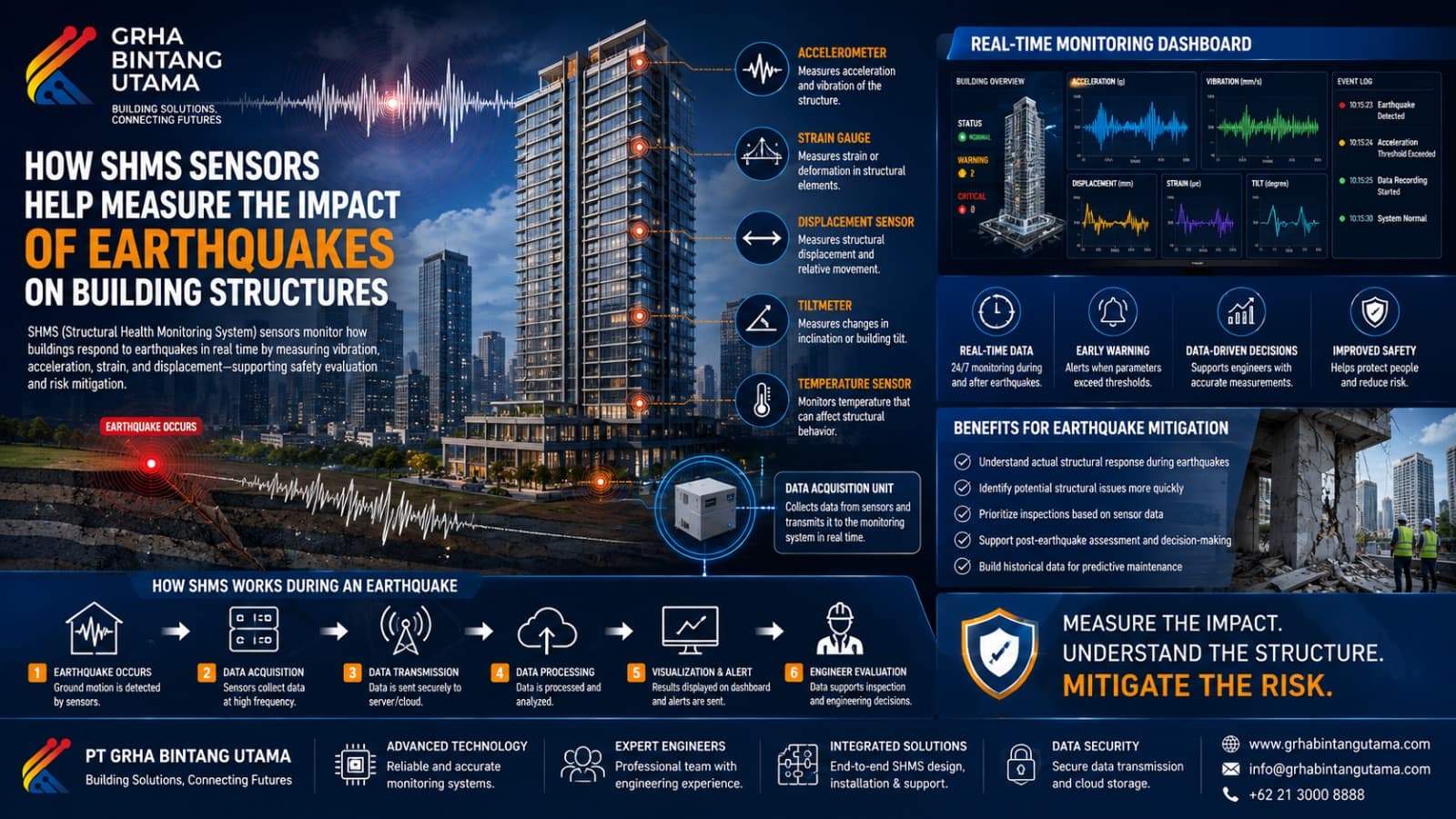
By integrating accelerometers, strain gauges, displacement sensors, tiltmeters, and other monitoring instruments, SHMS can record structural responses before, during, and after an earthquake.
The U.S. Geological Survey (USGS) operates extensive seismic monitoring systems and explains how earthquake instrumentation provides important data for understanding ground motion and seismic hazards. Learn about the USGS Earthquake Hazards Program
What Are SHMS Sensors for Earthquakes?
A Structural Health Monitoring System is a technology-based monitoring system that uses sensors and data acquisition equipment to measure the physical behavior of structures.
For seismic monitoring, SHMS Sensors for Earthquakes can be installed at strategic locations throughout a building.
The location and number of sensors should be determined based on structural characteristics, engineering requirements, monitoring objectives, and risk assessments.
A simplified SHMS architecture can be described as:
Sensors → Data Acquisition → Communication Network → Data Processing → Analytics → Dashboard → Alert
When an earthquake occurs, sensors capture the structural response.
The measurements are transferred to a data acquisition system, processed, stored, and displayed through a monitoring dashboard.
Engineers can then use this information as one source of data when evaluating structural performance.
Importantly, SHMS does not replace physical inspections or professional engineering judgment. Instead, it functions as a decision-support system providing quantitative measurements that strengthen structural assessments.
1. Accelerometers Measure Acceleration and Vibration
One of the most important sensors for seismic structural monitoring is the accelerometer.
During an earthquake, seismic waves cause ground acceleration. This motion is transmitted through the foundation into the building, causing the structure to respond dynamically.
Accelerometers can be installed at multiple elevations to record structural acceleration.
The collected data can help engineers evaluate:
- vibration intensity;
- acceleration at different building levels;
- dynamic structural response;
- changes in vibration characteristics;
- building response during seismic events.
For high-rise buildings, accelerometers installed at the lower, middle, and upper levels can provide information about how structural response varies with height.
The National Institute of Standards and Technology (NIST) conducts extensive research related to structural engineering, infrastructure resilience, and structural performance under different hazards. Explore Structural Engineering research from NIST
2. Strain Gauges Measure Structural Strain
When a building experiences seismic forces, structural components can undergo deformation.
A strain gauge measures strain or small changes in deformation within selected structural elements.
Sensors can be installed at critical locations based on engineering analysis.
Strain measurements may help engineers:
- compare structural responses before and after an event;
- identify changes in strain patterns;
- monitor the response of selected structural components;
- support post-earthquake engineering evaluations.
Strain measurements become even more valuable when combined with acceleration, displacement, temperature, and other monitoring data.
Instead of understanding only how strongly a building vibrated, engineers can obtain additional information regarding how specific structural components responded during the seismic event.
3. Displacement Sensors Measure Structural Movement
Earthquakes can cause buildings to experience lateral movement and relative displacement.
A displacement sensor measures changes in the position of a structural component relative to a reference point.
Within an SHMS, displacement monitoring may provide information regarding:
- structural movement;
- changes in component position;
- movement at selected joints;
- differences between pre-event and post-event conditions.
For high-rise buildings, monitoring structural movement can provide valuable information when assessing seismic response.
However, displacement measurements should not be interpreted independently.
They should be evaluated alongside baseline conditions, engineering thresholds, structural characteristics, and other monitoring parameters.
4. Tiltmeters Measure Changes in Inclination
In addition to acceleration and displacement, changes in structural inclination may also be relevant.
A tiltmeter is designed to measure small changes in angle or inclination.
Tiltmeters can help identify changes in structural orientation before and after an earthquake.
If post-earthquake measurements show a meaningful difference from the established baseline, the information may indicate that further engineering assessment is necessary.
However, changes in sensor readings do not automatically indicate structural damage.
Temperature effects, settlement, environmental conditions, sensor characteristics, and other variables must also be considered during engineering evaluation.
Why Is Pre-Earthquake Baseline Data Important?
One of the greatest advantages of SHMS is its ability to establish baseline data.
Before an earthquake occurs, the system continuously collects information about how a structure behaves under normal operating conditions.
The monitoring process can be simplified as:
Normal Baseline → Earthquake Event → Structural Response → Post-Earthquake Condition → Comparison & Evaluation
Engineers can then compare structural characteristics before and after the event.
If significant changes occur in acceleration patterns, natural frequencies, strain, displacement, tilt, or other parameters, the information can be used to prioritize additional assessment.
This is an important advantage of continuous monitoring.
Rather than installing measurement instruments only after an event, SHMS provides records from before, during, and after the earthquake.
From Seismic Data to Early Warning
SHMS Sensors for Earthquakes can also be integrated with monitoring thresholds and automated alerts.
For example, a monitoring dashboard can use several condition levels:
NORMAL
Measured parameters remain within established baseline or operational limits.
WARNING
A change or anomaly requires attention or further engineering evaluation.
CRITICAL
One or more parameters exceed predetermined thresholds and require action according to established safety procedures.
When sensor measurements exceed configured limits, the system can generate notifications for operators or engineers.
However, it is important to distinguish between an earthquake early warning system and a structural monitoring alert.
Earthquake early warning systems aim to detect an earthquake rapidly and provide advance notice before strong shaking reaches certain locations.
SHMS, in contrast, primarily focuses on measuring how a specific structure responds to the seismic event.
The USGS ShakeAlert system demonstrates how seismic sensor networks can support rapid earthquake detection and early warning. Learn about the USGS ShakeAlert Earthquake Early Warning System
Supporting Post-Earthquake Building Assessment
After a significant earthquake, structural inspection becomes critically important.
Under conventional assessment procedures, engineers inspect buildings for cracks, deformation, damaged connections, material failure, and other visible indications.
SHMS can complement this process.
For example, the monitoring system may indicate that an accelerometer at a particular floor recorded an unusual response, or a strain sensor may show a significant change compared with its historical baseline.
This information can help engineers identify areas that deserve priority during physical inspections.
As a result, post-earthquake assessment can become more targeted and data-driven.
SHMS does not automatically determine whether a building is safe or unsafe.
Instead, it provides an additional layer of information that supports professional engineering assessment.
SHMS for High-Rise Buildings
The implementation of SHMS Sensors for Earthquakes can be particularly valuable for high-rise buildings because structural responses may vary significantly across different elevations.
Sensors may be distributed across:
- basement levels;
- lower floors;
- middle floors;
- upper floors;
- rooftop areas;
- selected critical structural components.
This configuration allows engineers to compare structural responses at different points throughout the building.
During an earthquake, the monitoring system can record how dynamic responses develop from the lower levels toward the upper sections of the structure.
The collected data can then support comparisons between actual building behavior and expected structural performance.
Supporting Earthquake Risk Mitigation
SHMS should be considered one component of a broader earthquake risk mitigation strategy.
Effective seismic safety still depends on appropriate structural design, compliance with applicable standards, regular inspections, preventive maintenance, emergency response planning, and occupant preparedness.
The Federal Emergency Management Agency (FEMA) provides extensive resources related to earthquake risk reduction, building safety, and seismic mitigation. Explore Earthquake Risk Management resources from FEMA
SHMS strengthens these approaches by adding actual measurement data.
With real-time and historical information, building owners and engineers gain additional insight into how structures respond to real seismic events.
Integrating SHMS with Smart Buildings
Modern SHMS technology can also become part of a wider smart-building ecosystem.
A centralized dashboard may display:
- acceleration;
- vibration;
- strain;
- displacement;
- inclination;
- sensor status;
- historical trends;
- event recordings;
- alarm history.
Depending on project requirements, SHMS can also be integrated with Internet of Things platforms, Building Management Systems, CCTV, command centers, cloud infrastructure, artificial intelligence, data analytics, and digital twins.
Such integration can make structural safety information part of a broader building management strategy.
From Reactive Response to Data-Driven Mitigation
Traditional approaches often focus heavily on assessment after an earthquake has already occurred.
With SHMS, the process can become more proactive:
Continuous Monitoring → Event Detection → Structural Response Analysis → Physical Inspection → Engineering Evaluation → Mitigation Action
Historical measurements also allow engineers to understand how structural behavior changes over time.
This means SHMS provides value even when no earthquake is occurring.
Daily monitoring establishes the baseline information required to make meaningful comparisons when an extreme event eventually occurs.
Implementing SHMS with PT Grha Bintang Utama
As a company providing technology and infrastructure solutions, PT Grha Bintang Utama can support Structural Health Monitoring System implementation based on the characteristics and requirements of individual projects.
A comprehensive implementation process may include:
Site Assessment → Engineering Study → Sensor Mapping → System Design → Installation → Integration → Commissioning → Monitoring & Maintenance
Sensor selection should not simply be based on the number of devices installed.
A more important engineering question is:
“What data is required to understand how the structure responds when an earthquake occurs?”
Based on this objective, engineers can determine the appropriate sensor types, installation locations, sampling rates, communication systems, data acquisition equipment, thresholds, dashboards, and historical data storage requirements.
With an engineering-driven approach, SHMS can become an important component of a building's safety and earthquake risk mitigation strategy.
Conclusion
Earthquakes can generate significant dynamic loads on building structures, while their effects cannot always be fully understood through visual inspection alone.
SHMS Sensors for Earthquakes provide quantitative information about how a building actually responds during seismic events.
Accelerometers measure acceleration and vibration, strain gauges monitor deformation, displacement sensors measure structural movement, and tiltmeters provide information about changes in inclination.
When these measurements are integrated into a Structural Health Monitoring System, engineers can obtain a more comprehensive understanding of structural response.
SHMS does not replace physical inspection or professional engineering assessment. Instead, it strengthens both by providing real-time measurements, historical baselines, event recordings, and automated alerts.
A comprehensive structural safety approach therefore combines:
Real-Time Monitoring + Physical Inspection + Engineering Evaluation + Risk Mitigation
Through this approach, building safety management can evolve from simply reacting after an earthquake toward a more proactive and data-driven strategy:
Measure the Impact. Understand the Structure. Mitigate the Risk.
WIM System in Indonesia for Weighing Trucks Without Stopping
Read More
How SHMS Sensors Help Measure the Impact of Earthquakes on Building Structures
Read More
Early Detection of Electrical Panel Overheating Using Wireless Temperature Sensors for Plant Safety.
Read More

Jakarta Selatan, [email protected] 0812-1146-0008