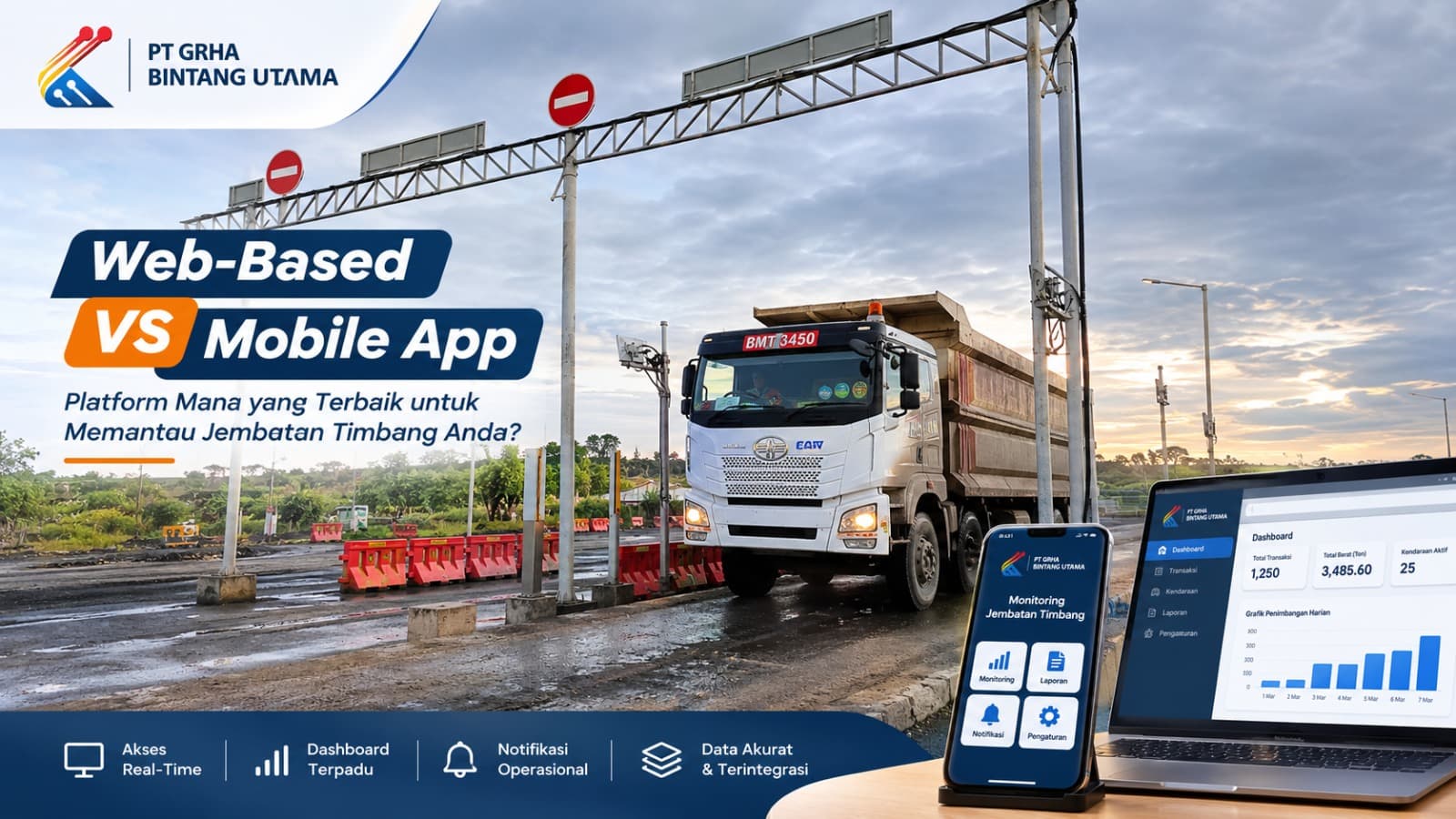
Web-Based vs Mobile App: Choosing the Best Platform for Weighbridge Monitoring
Author
Web-Based vs. Mobile App: Which Platform Is Best for Monitoring Your Weighbridge?
Introduction
In the logistics, mining, manufacturing, and transportation industries, weighbridges play an essential role in maintaining reliable vehicle weighing operations. They support material movement, transportation control, transaction recording, and the efficient management of commercial activities.
As digital transformation continues to reshape industrial operations, weighbridge monitoring has become increasingly important for organizations seeking better visibility, accountability, and operational efficiency.
Traditionally, weighbridge operators relied on weighing indicators, manually recorded information, and local computer systems. Today, modern digital systems can connect weighing equipment to databases and monitoring dashboards that provide easier access to operational data.
Two commonly considered solutions are web-based monitoring platforms and mobile applications.
Both provide different ways to monitor weighing transactions, review operational performance, and access important information. However, their suitability depends on the organization's infrastructure, user requirements, operating locations, and security expectations.
Understanding these differences can help businesses make better investment decisions.
1. What Is Web-Based Weighbridge Monitoring?
Web-based weighbridge monitoring is a digital solution accessed through an internet browser, such as Google Chrome, Microsoft Edge, or Safari.
Instead of relying on dedicated applications installed on individual devices, users access the monitoring platform through a compatible browser.
When integrated with weighing equipment, the system can receive information from weighing indicators, communication gateways, or local computers and process it through a centralized database.
The dashboard may display essential information such as vehicle identification, weighing timestamps, gross weight, tare weight, net weight, transaction records, system status, and operational reports.
For companies operating multiple weighbridges, a centralized web dashboard can provide a consolidated view of activities across different facilities.
AWS IoT SiteWise describes how industrial data can be visualized through web applications to support asset monitoring, historical analysis, and operational decision-making.
Similar principles can be applied to digital weighing systems, provided that the relevant equipment and software are properly integrated.
2. Advantages of Web-Based Monitoring
Comprehensive Data Visualization
One of the main advantages of web-based monitoring is its ability to present complex operational information through larger screens.
Managers and operators can access detailed transaction tables, historical trends, operational charts, and equipment status indicators.
A mining company operating several weighing stations, for example, may use a centralized dashboard to review weighing volumes across locations and identify differences in operational activity.
Centralized Multi-Site Management
Organizations with weighbridges at multiple facilities often face challenges when consolidating operational records.
Different reporting procedures and disconnected systems can slow down decision-making.
Web-based monitoring can help centralize data from multiple weighing locations when the required network connectivity and integration infrastructure are available.
This makes it easier to compare performance, review transactions, and produce management reports.
Easier Application Maintenance
Web applications can generally be updated on the server without requiring users to manually install every software update.
This approach may simplify software deployment and ongoing maintenance.
However, successful implementation still requires compatibility testing, cybersecurity controls, and careful management of application changes.
Detailed Reporting and Analysis
Web-based systems are particularly suitable for businesses that require comprehensive reports.
Depending on the software design, users can generate daily, weekly, or monthly reports covering vehicle volumes, total weighed tonnage, operational activity, and transaction history.
Historical data can also support investigations into recurring delays, transaction inconsistencies, or unusual operating patterns.
3. What Is a Mobile Weighbridge Monitoring App?
A mobile weighbridge monitoring app is a software solution designed for smartphones or tablets.
It can be developed as a native Android or iOS application or implemented through web technologies such as Progressive Web Apps.
Mobile applications focus on convenient access to essential information while users are away from their desks.
For example, a supervisor performing a field inspection can review the latest weighing activity, equipment connectivity status, or transaction summary without returning to the control room.
The Mozilla Developer Network explains how Progressive Web Apps can provide application-like experiences through web technologies, including installation capabilities and certain offline functions when appropriately designed.
Nevertheless, offline access, background operations, and notifications should not be assumed to work automatically on every device or application.
These features depend on implementation and platform support.
4. Advantages of Mobile Applications
Convenient Access from Anywhere
Mobile monitoring provides practical access for managers and field personnel who frequently move between operational locations.
Instead of opening a laptop, users can review selected operational indicators through their smartphones.
This is particularly beneficial in mining sites, logistics terminals, industrial facilities, and other operations where supervisors spend significant time in the field.
Operational Notifications
Mobile applications can support notifications when important events require attention.
For example, a properly configured system may notify authorized users when communication with a weighbridge is interrupted, an equipment issue occurs, or a transaction requires investigation.
Notifications can improve awareness and help supervisors prioritize their responses.
However, alerts should be carefully designed to avoid excessive or unnecessary messages.
Better Support for Field Supervision
During physical inspections, supervisors may need to confirm vehicle details, review recent transactions, or check the status of weighing equipment.
A mobile application can provide access to this information based on the user's assigned permissions.
This creates a more practical connection between field activities and centralized operational records.
Simplified User Interface
Mobile applications usually prioritize important information rather than displaying every available data field.
Typical mobile dashboards might show the number of vehicles processed, total tonnage, recent weighing transactions, equipment status, and active alerts.
This makes mobile applications suitable for users who need quick operational insights rather than complex analysis.
5. Web-Based vs. Mobile App: Key Differences
| Feature | Web-Based Platform | Mobile Application |
|---|---|---|
| Primary access | Desktop or mobile browser | Smartphone or tablet |
| Dashboard | Detailed operational views | Compact mobile-friendly views |
| Reporting | Suitable for comprehensive analysis | Suitable for quick summaries |
| Notifications | Dashboard, email, or supported web notifications | Can provide push notifications |
| System updates | Typically managed centrally | Depends on deployment method |
| Offline support | Possible with suitable architecture | Possible with local data storage |
| Field operations | Depends on responsive design | Generally more convenient |
| Implementation cost | Depends on system complexity | Depends on features and supported platforms |
These characteristics are general considerations rather than fixed limitations. Modern web applications can offer many features traditionally associated with mobile apps.
6. Data Security in Weighbridge Monitoring
Security is essential for both platforms because weighing transactions may contain sensitive operational and commercial information.
This information may include vehicle identities, material quantities, transaction histories, and internal logistics activities.
Businesses should consider authentication, role-based access control, encrypted communications, backup procedures, audit trails, and appropriate access monitoring.
The NIST Cybersecurity Framework provides guidance for managing organizational cybersecurity risks.
For mobile application development, the OWASP Mobile Application Security Verification Standard offers security controls addressing data storage, authentication, network communication, and other important requirements.
Neither web-based nor mobile applications are automatically more secure.
The actual security level depends on system architecture, software quality, deployment configuration, maintenance practices, and organizational procedures.
7. Integration with Weighbridge Equipment
The quality of a monitoring platform depends heavily on the reliability of its underlying data.
Even a well-designed dashboard cannot compensate for inaccurate weighing measurements or incomplete transaction records.
For conventional non-automatic weighing instruments, OIML Recommendation R76 provides internationally recognized metrological and technical requirements.
Weigh-in-Motion systems, which measure vehicles while they are moving, have different operational principles and technical requirements.
Indonesia's Directorate General of Highways also provides guidance on collecting vehicle axle-load data using Weigh-in-Motion technologies.
These references demonstrate why the underlying measurement method must be understood before designing a monitoring solution.
Integration should consider indicator compatibility, communication protocols, transaction validation, time synchronization, database reliability, and equipment status.
It is equally important to distinguish verified weighing results from incomplete or temporarily unavailable data.
8. What Happens When Internet Connectivity Is Lost?
Connectivity can be a significant challenge in remote mining areas, plantations, and industrial facilities.
A reliable monitoring architecture should consider how weighing operations continue when external network connections become unstable.
One approach involves keeping transaction processing and local data storage operational at the weighing site.
When connectivity is restored, the system can synchronize eligible records with a central database.
Both web-based and mobile platforms can support elements of this approach when their architecture has been designed accordingly.
However, users must be able to distinguish live data from cached or previously synchronized information.
Monitoring dashboards should display communication status and the latest successful update time so managers do not mistake outdated information for current operating conditions.
9. Which Platform Should Your Business Choose?
Choosing the best weighbridge monitoring platform depends on operational requirements.
Web-based monitoring is generally well suited for companies that need detailed reports, multi-location management, transaction analysis, and centralized operational supervision.
Mobile applications are particularly valuable when managers and supervisors require quick access to information while working in the field.
For larger organizations, a hybrid approach may offer greater flexibility.
Under a hybrid model, the web platform serves as the main environment for administration, reporting, and operational analysis, while mobile applications provide simplified access to important information and notifications.
Both interfaces can connect to a shared backend and database, improving information consistency and reducing duplicated data entry.
Before making an investment, businesses should evaluate user roles, operational locations, system costs, connectivity, security requirements, and long-term maintenance responsibilities.
10. PT Grha Bintang Utama and Smart Weighing Infrastructure
PT Grha Bintang Utama operates in the smart infrastructure and transportation technology sector, with experience involving Weigh-in-Motion systems, monitoring facilities, and weighing system maintenance.
This experience highlights the importance of connecting field equipment, communication systems, data processing, and operational supervision.
Businesses considering digital weighbridge monitoring should begin by assessing their existing equipment and identifying the information that different users need.
Depending on the project requirements, organizations may evaluate centralized web dashboards, mobile interfaces, or integrated monitoring environments.
The objective should not simply be to create an attractive digital application.
A successful monitoring solution should help users understand reliable operational data, identify issues, support reporting, and make informed decisions.
Conclusion
Both web-based platforms and mobile applications can play important roles in modern weighbridge monitoring.
Web-based systems are particularly useful for centralized control, detailed reporting, and operational analysis. Mobile applications offer convenient access, field supervision, and the potential for faster notification of important events.
For organizations requiring both detailed management capabilities and flexible field access, combining the two approaches may provide the most practical solution.
Ultimately, platform selection should be based on data accuracy, integration capabilities, cybersecurity, network reliability, and the actual requirements of the people using the system.
Looking for a smarter approach to weighing infrastructure and monitoring?
Explore technology solutions and discuss your operational requirements with PT Grha Bintang Utama.
References
Source :
https://grhabintangutama.co.id/Tips for Choosing the Right Current Transformer (CT) for Reliable Industrial Electrical Monitoring S
Read More
Power Quality Monitoring: Why Unstable Voltage Can Damage Your Industrial Production Equipment
Read More
WIM System in Indonesia for Weighing Trucks Without Stopping
Read More

Jakarta Selatan, [email protected] 0812-1146-0008