Types of Sensors in Structural Health Monitoring Systems
Author
Why Are Sensors Important in SHMS?
Bridges, high-rise buildings, dams, towers, tunnels, and other civil infrastructure are continuously exposed to various loads and environmental conditions throughout their service life. Vehicle traffic, human activity, wind, temperature changes, vibration, earthquakes, corrosion, and material fatigue can gradually affect structural performance.
The challenge is that these changes are not always visible through conventional visual inspections. Small cracks, changes in strain, structural displacement, or variations in vibration characteristics may develop gradually without obvious external signs.
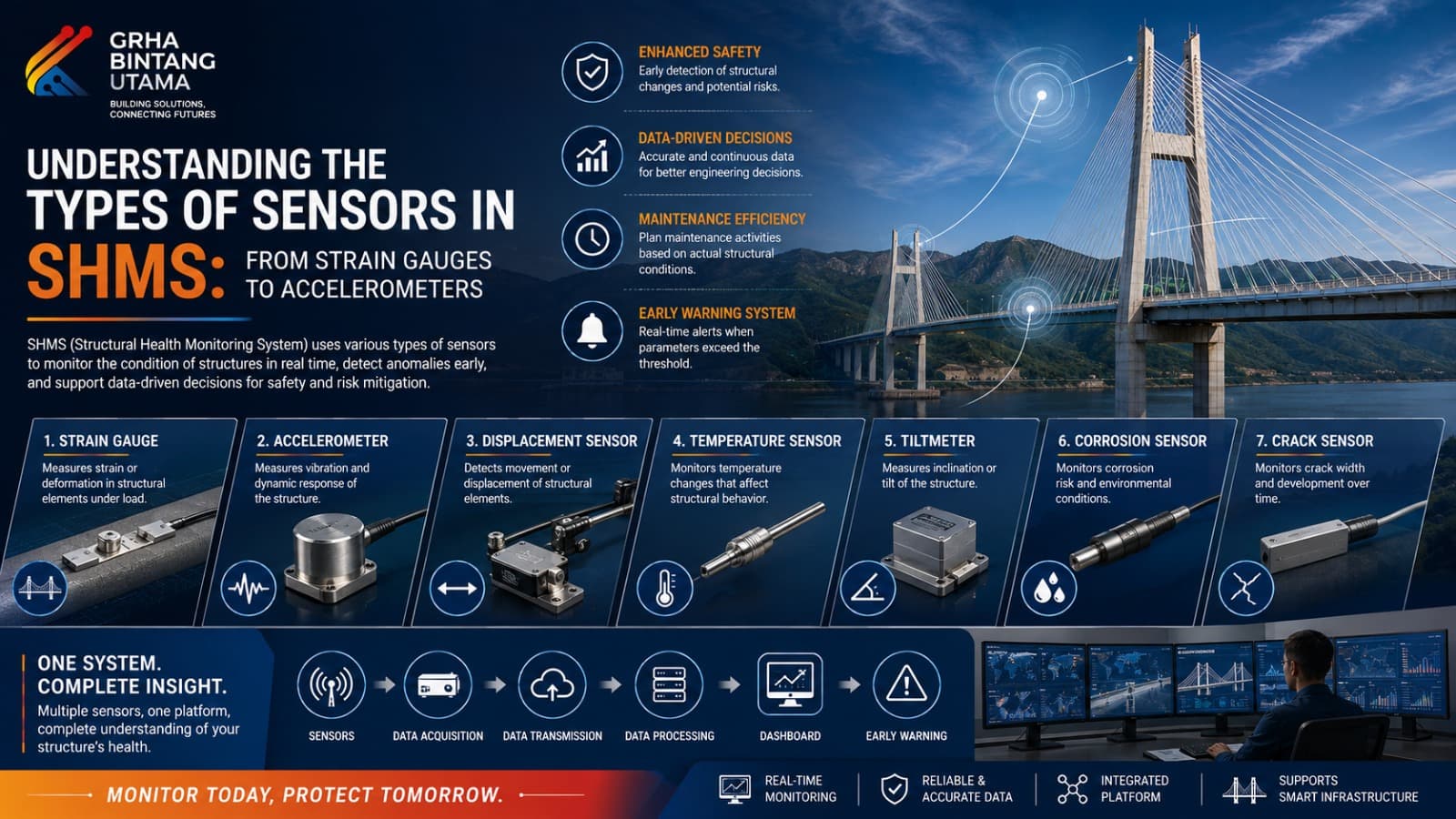
To improve monitoring capabilities, a Structural Health Monitoring System (SHMS) uses different Types of SHMS Sensors installed at strategic locations throughout a structure.
According to the U.S. Federal Highway Administration (FHWA), structural health monitoring technologies can use instrumentation to measure structural responses and provide valuable information about infrastructure conditions. Learn more about Structural Health Monitoring from FHWA.
Data collected by these sensors can then be transmitted, processed, analyzed, and displayed through a monitoring platform, enabling engineers to evaluate structural behavior based on actual measurements.
So, what types of sensors are commonly used in SHMS?
1. Strain Gauge – Measuring Structural Strain
One of the most important Types of SHMS Sensors is the strain gauge.
A strain gauge is designed to measure strain or deformation in a material when it is subjected to force. The sensor can be installed on selected structural elements to understand how those elements respond to applied loads.
When a structure receives a load, its materials may undergo extremely small changes in shape. A strain gauge detects these changes and converts them into measurable electrical signals.
Strain data can help engineers:
- monitor structural responses to loads;
- identify changes in stress and strain patterns;
- compare actual conditions against baseline data;
- evaluate load distribution;
- support structural condition assessments.
In bridge applications, strain gauges may be installed on girders, decks, or other critical structural elements based on engineering analysis.
National Instruments explains that strain gauge measurement is based on changes in electrical resistance caused by deformation. Learn more about strain gauge measurement.
2. Accelerometer – Measuring Vibration and Dynamic Response
In addition to strain, vibration is another important parameter in structural health monitoring.
An accelerometer measures acceleration and the dynamic response of a structure.
When heavy vehicles travel across a bridge, when strong winds affect a structure, or when an earthquake occurs, the structure experiences vibration. These vibrations have particular characteristics that can be measured and analyzed.
Accelerometers allow engineers to obtain information about:
- structural vibration levels;
- response to traffic loads;
- natural frequencies;
- changes in dynamic characteristics;
- response to earthquakes and extreme events.
Significant changes in vibration patterns can provide useful information indicating that structural behavior has changed and may require further engineering evaluation.
For this reason, accelerometers are among the most widely used Types of SHMS Sensors for bridges, high-rise buildings, dams, towers, and other large structures.
Research on bridge structural health monitoring highlights vibration-based monitoring as an important approach for assessing structural conditions. Read a review of Structural Health Monitoring for bridges.
3. Displacement Sensor – Detecting Structural Movement
Structures are not completely static.
Loads, temperature variations, ground movements, environmental conditions, and operational activities can cause parts of a structure to move.
A displacement sensor measures changes in the position of a structural component relative to a reference point.
In SHMS applications, displacement sensors can be used to monitor:
- expansion joint movements;
- bridge deck displacement;
- structural movement;
- bearing displacement;
- deformation of specific components.
If displacement measurements show significant deviations from established baseline conditions, engineers can investigate the situation further.
Historical displacement data is also useful because it enables engineers to understand how a structure behaves over longer periods.
4. Temperature Sensor – Understanding Environmental Effects
Temperature can significantly influence structural behavior.
Materials such as steel and concrete expand as temperatures increase and contract as temperatures decrease.
As a result, changes in strain or displacement do not necessarily indicate structural deterioration. They may simply represent normal responses to environmental temperature variations.
A temperature sensor helps engineers understand the relationship between temperature changes and structural responses.
By combining temperature data with strain, displacement, vibration, and other parameters, engineers can interpret structural behavior with greater context.
This is particularly important for long-span bridges and other structures that experience substantial environmental temperature variations.
5. Tiltmeter – Measuring Structural Inclination
A tiltmeter measures changes in the angle or inclination of a structure with high precision.
Tiltmeters can be applied to:
- bridges;
- retaining walls;
- high-rise buildings;
- towers;
- dams;
- geotechnical structures.
Gradual changes in inclination can provide important information about structural or ground movement.
Within an SHMS, tiltmeter measurements can be combined with displacement data and other sensor measurements to provide a more comprehensive understanding of structural conditions.
6. Corrosion Sensor – Monitoring Corrosion Risks
Corrosion is a major factor contributing to infrastructure degradation, particularly in steel structures and reinforced concrete.
Exposure to water, moisture, salt, chemicals, and aggressive environmental conditions can accelerate corrosion.
For this reason, certain SHMS implementations incorporate corrosion sensors to help monitor parameters associated with corrosion processes.
This information can support preventive maintenance strategies by helping infrastructure owners identify potential deterioration before it develops into more significant structural damage.
Corrosion monitoring is particularly valuable for bridges located in coastal areas, industrial environments, or locations with high humidity.
7. Crack Sensor – Monitoring Crack Development
Cracks are among the most commonly observed indicators during structural inspections.
A crack sensor can be used to monitor changes in crack width or the development of an existing crack at a specific location.
Unlike visual inspections conducted periodically, sensors can provide more continuous information about crack behavior.
The collected data can help determine whether a crack remains relatively stable or continues to develop over time.
This information can then support further engineering assessment and maintenance decisions.
How Do Different SHMS Sensors Work Together?
The true value of SHMS does not come from a single sensor.
Its greatest advantage emerges when different Types of SHMS Sensors operate as part of an integrated monitoring system.
A simplified architecture can be represented as:
Sensors → Data Acquisition Unit → Communication Network → Server/Cloud → Analytics → Dashboard → Early Warning
Each sensor contributes different information.
A strain gauge provides strain measurements.
An accelerometer provides vibration and dynamic-response data.
A displacement sensor measures structural movement.
Temperature sensors provide environmental context.
Tiltmeters measure inclination.
Corrosion and crack sensors provide additional information about material and structural conditions.
Combining these measurements creates a more comprehensive understanding of how infrastructure behaves over time.
The National Institute of Standards and Technology (NIST) also highlights the role of sensing, data, connectivity, and cyber-physical technologies in the development of smart communities and infrastructure. Explore smart infrastructure concepts from NIST.
From SHMS Sensors to an Early Warning System
Modern SHMS technology can do more than simply record structural data.
A monitoring platform can be configured with predetermined thresholds or operating limits.
For example:
NORMAL
Structural parameters remain within predetermined operating limits.
WARNING
A change or anomaly has been detected that requires attention or engineering evaluation.
CRITICAL
One or more parameters exceed established thresholds and require action according to the applicable safety procedure.
When sensors detect abnormal conditions, the information can be transmitted to a centralized monitoring dashboard, where the system may generate alerts or notifications.
However, an SHMS alarm does not automatically mean that a structure is unsafe or about to fail.
The information must be evaluated by qualified engineers while considering structural design, site conditions, historical trends, environmental effects, and other relevant parameters.
Therefore, SHMS should be understood as a decision-support system, rather than an automatic replacement for professional engineering judgment.
SHMS and Predictive Maintenance
One of the greatest advantages of implementing different Types of SHMS Sensors is the availability of historical data.
Measurements collected over months or years allow engineers and asset owners to analyze changes in structural behavior over time.
This capability can support a transition from:
Reactive Maintenance → Preventive Maintenance → Condition-Based Maintenance → Predictive Maintenance
Under a reactive approach, maintenance is often performed after a problem has already occurred.
With condition-based monitoring, actual structural data can help determine when additional inspection, assessment, or maintenance may be required.
The result is a more informed infrastructure management strategy based on actual asset conditions rather than relying exclusively on predetermined maintenance schedules.
Supporting Safer and Smarter Infrastructure
SHMS can also become an important part of a wider smart infrastructure ecosystem.
Depending on project requirements, monitoring platforms can potentially integrate with technologies such as:
- Internet of Things (IoT);
- cloud computing;
- centralized monitoring dashboards;
- artificial intelligence;
- machine learning;
- automated notifications;
- digital twins;
- data analytics.
The objective is not simply to generate more data.
The objective is to transform structural measurements into useful information that helps engineers, operators, and asset owners make better decisions.
SHMS Implementation with PT Grha Bintang Utama
As a company providing technology and infrastructure solutions, PT Grha Bintang Utama can support the implementation of Structural Health Monitoring Systems according to project requirements and site conditions.
A proper SHMS implementation should begin by understanding the structure, operational environment, monitoring objectives, and potential risks.
The implementation process may include:
Site Assessment → Engineering Study → Sensor Selection → System Design → Installation → Integration → Monitoring → Maintenance
Selecting the appropriate Types of SHMS Sensors should not simply be based on installing as many sensors as possible.
Instead, the fundamental question should be:
“What information is required to understand structural conditions and support better decisions?”
Based on this objective, engineers can determine the appropriate sensor types, installation locations, communication methods, measurement intervals, thresholds, and dashboard configurations.
This engineering-based approach can produce a monitoring system that is more relevant, efficient, and useful throughout the infrastructure lifecycle.
Conclusion
A Structural Health Monitoring System provides a data-driven approach to understanding how infrastructure behaves throughout its operational life.
Different Types of SHMS Sensors, including strain gauges, accelerometers, displacement sensors, temperature sensors, tiltmeters, corrosion sensors, and crack sensors, perform different but complementary functions.
Strain gauges measure deformation, accelerometers monitor dynamic response, displacement sensors detect movement, while other sensors provide additional information about environmental and structural conditions.
When these sensors are integrated with data acquisition systems, communication networks, analytics, dashboards, and warning mechanisms, SHMS can provide a more comprehensive picture of structural behavior.
SHMS does not replace physical inspections or professional engineering expertise. Instead, it strengthens these activities by providing real-time data, historical trends, and early-warning information that can support better decisions.
Ultimately, the purpose of SHMS is not simply to install sensors.
The objective is to create infrastructure that is safer, more measurable, more resilient, and better prepared for potential risks through data-driven decision-making.
URL Sources / References
- Federal Highway Administration (FHWA) — Structural Health Monitoring of Bridge Structures
https://www.fhwa.dot.gov/publications/research/infrastructure/structures/bridge/09040/001.cfm - National Instruments — Strain Gauge Measurement
https://www.ni.com/docs/en-US/bundle/ni-motion/page/strain-gage.html - MDPI — The Current Development of Structural Health Monitoring for Bridges: A Review
https://www.mdpi.com/2075-5309/13/6/1360 - National Institute of Standards and Technology (NIST) — Smart Cities and Communities
https://www.nist.gov/topics/smart-cities-and-communities
Types of Sensors in Structural Health Monitoring Systems
Read More
Static vs. Dynamic Weighbridges (WIM): When Should Your Business Choose One?
Read More
Early Detection of Electrical Panel Overheating Using Wireless Temperature Sensors for Plant Safety.
Read More

Jakarta Selatan, [email protected] 0812-1146-0008