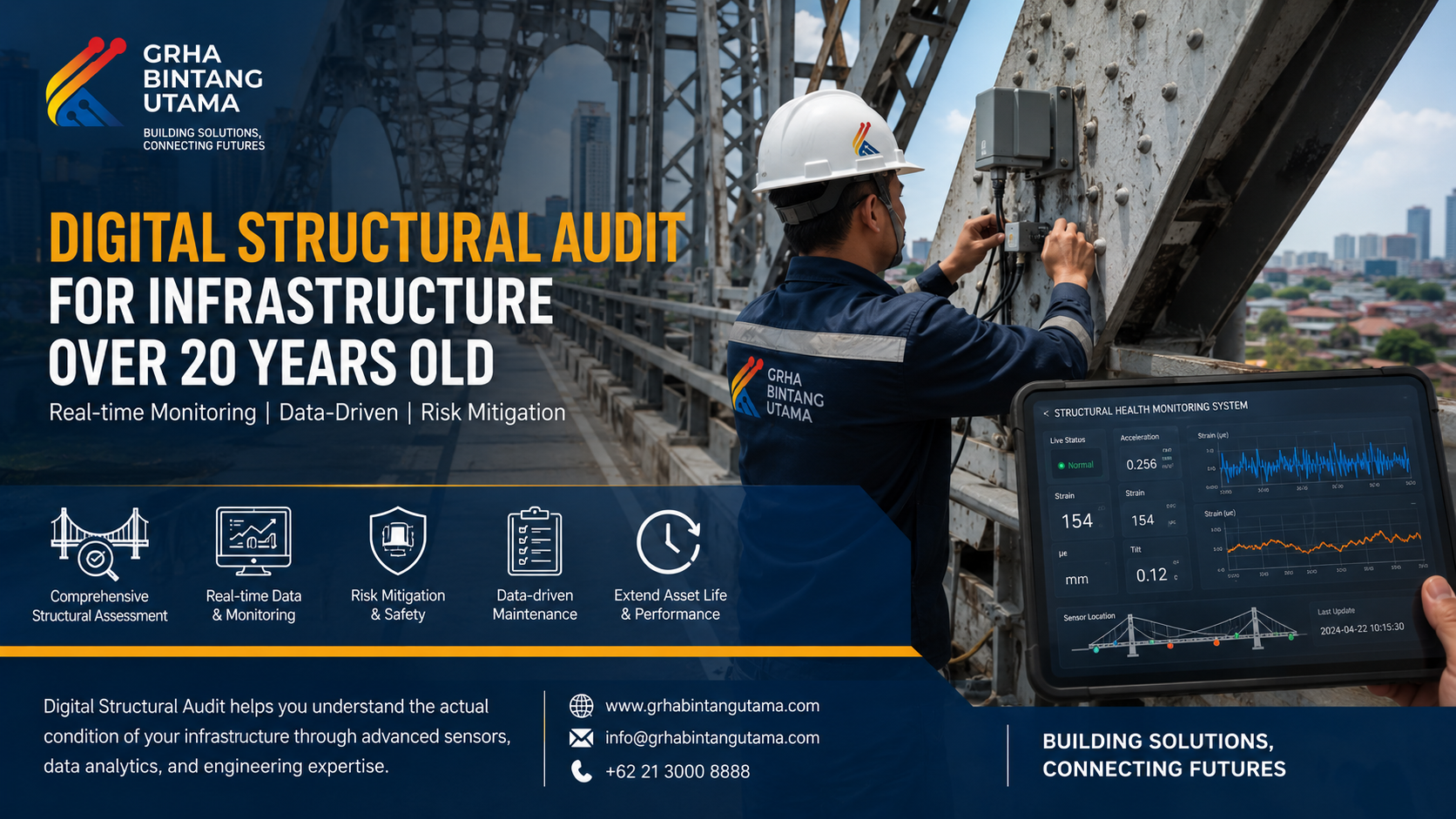
The Importance of Digital Structural Audits for Infrastructure Over 20 Years Old
Author
The Importance of Digital Structural Audits for Infrastructure Over 20 Years Old
Bridges, buildings, flyovers, dams, towers, industrial facilities, and other civil infrastructure are designed to operate for long periods. However, as infrastructure ages, understanding its actual condition becomes increasingly important for maintaining safety, performance, and serviceability.
Infrastructure that has been operating for more than 20 years may have experienced thousands or even millions of loading cycles. Vehicle traffic, human activity, machinery vibration, wind, temperature fluctuations, humidity, earthquakes, corrosion, and environmental exposure can gradually influence structural materials and components.
However, reaching 20 years of age does not automatically mean that an infrastructure asset is unsafe. Actual structural condition depends on many factors, including original design, construction quality, material properties, maintenance history, operating loads, environmental exposure, modifications, and changes in asset function.
Nevertheless, as the operational age of infrastructure increases, systematic evaluation becomes increasingly valuable.
This is where a Digital Structural Audit can provide an additional approach for helping asset owners understand infrastructure conditions through a combination of engineering inspections, sensors, instrumentation, historical data, and Structural Health Monitoring Systems (SHMS).
The U.S. Federal Highway Administration (FHWA) highlights the importance of bridge preservation strategies in maintaining infrastructure performance throughout its lifecycle. Learn more about Bridge Preservation from FHWA
What Is a Digital Structural Audit?
A Digital Structural Audit can be understood as an approach to evaluating structural conditions using digital technologies to complement conventional engineering inspections.
Depending on the type of infrastructure and project objectives, this approach may involve:
- Structural Health Monitoring Systems;
- strain gauges;
- accelerometers;
- displacement sensors;
- tiltmeters;
- crack monitoring sensors;
- corrosion monitoring;
- data acquisition systems;
- cloud-based monitoring;
- centralized dashboards;
- historical trend analysis;
- digital documentation.
The purpose is not simply to convert conventional inspection reports from paper into digital documents.
The greater value lies in obtaining measurable data about structural behavior and changes over time, allowing maintenance and risk mitigation decisions to be supported by more comprehensive information.
Why May Visual Inspection Alone Not Be Enough?
Visual inspection remains a fundamental part of infrastructure assessment.
Qualified engineers can identify indications such as cracks, corrosion, deformation, concrete spalling, leakage, damaged connections, and other physical changes.
However, not every change in structural behavior can be identified visually.
For example, strain changes in a particular structural element may occur on a scale too small to be seen by the human eye. Changes in vibration characteristics also require instrumentation to be measured quantitatively.
Therefore, a Digital Structural Audit does not replace manual inspection.
A more comprehensive approach combines:
Visual Inspection + Instrumentation + Historical Data + Engineering Analysis
The National Institute of Standards and Technology (NIST) conducts extensive research in structural engineering, including the performance, safety, and resilience of buildings and infrastructure. Explore Structural Engineering research from NIST
Key Risks to Consider in Aging Infrastructure
After decades of operation, several factors may require additional attention from asset owners and engineers.
1. Material Fatigue
Structures subjected to repeated loading can experience material fatigue.
A bridge, for example, may experience repeated loading cycles every time vehicles travel across it. Industrial facilities can similarly experience repeated dynamic loads from machinery and operations.
Over a long period, understanding these loading patterns and structural responses becomes increasingly valuable.
This is one reason historical monitoring data can provide important additional information for aging infrastructure.
2. Corrosion
Steel components and reinforcement embedded in concrete may be affected by corrosion.
Water, humidity, salt, chemicals, and aggressive environmental conditions can accelerate material degradation.
If corrosion continues to develop, it may affect structural performance and require appropriate inspection, maintenance, repair, or further engineering assessment.
Digital monitoring technologies can provide additional information to support these activities.
3. Cracking
Cracks can develop for many reasons, including shrinkage, temperature effects, loading, settlement, material deterioration, and other structural conditions.
The important question is not simply:
“Is there a crack?”
Another critical question is:
“Is the crack stable, or is it continuing to develop?”
Digital crack monitoring can provide historical measurements of changes in crack width, allowing engineers to evaluate trends over time.
4. Changes in Operational Loads
Infrastructure constructed 20 or 30 years ago may now operate under significantly different conditions.
Traffic volumes may have increased.
Industrial machinery may have been replaced with higher-capacity equipment.
A building may have changed its function.
Additional equipment may have been installed.
These changes can influence the loads experienced by structural components.
Therefore, evaluating aging infrastructure should consider not only its chronological age but also how its operational environment has changed.
How Do Sensors Support a Digital Structural Audit?
One important component of a Digital Structural Audit is sensor-based monitoring.
Different sensors provide different types of structural information.
Strain Gauge
A strain gauge measures strain or deformation within a selected structural element.
The data can help engineers understand how the component responds to loads.
Accelerometer
Accelerometers measure acceleration, vibration, and dynamic structural response.
These sensors can be particularly useful for bridges, high-rise buildings, towers, and other structures affected by dynamic loading.
Displacement Sensor
A displacement sensor measures changes in the position or movement of selected structural components.
Tiltmeter
A tiltmeter measures changes in structural inclination or angle.
Temperature Sensor
Temperature sensors provide environmental information that can help engineers distinguish normal thermal responses from other structural changes.
Crack Sensor
Crack monitoring sensors can measure changes in the width or movement of existing cracks.
Corrosion Monitoring Sensor
Depending on project requirements, corrosion monitoring systems can provide additional information related to material deterioration and environmental conditions.
Importantly, every project does not require every type of sensor.
Sensor selection should be based on engineering requirements, structural characteristics, and the specific risks that need to be monitored.
From Point-in-Time Measurements to Historical Data
One of the most significant advantages of digital monitoring is the ability to establish historical datasets.
A conventional inspection provides valuable information regarding conditions at the time the inspection is performed.
Continuous or periodic digital monitoring allows measurements to be compared over much longer periods:
Today → 1 Month → 6 Months → 1 Year → Multiple Years
These historical trends can help engineers determine whether monitored parameters remain relatively stable or gradually change.
This capability is particularly important for aging infrastructure because deterioration does not always occur suddenly.
Some changes develop slowly over months or years.
Historical monitoring therefore provides asset owners with an additional source of information for determining whether further inspection or engineering evaluation may be required.
Integrating Digital Structural Audits with SHMS
For critical infrastructure, a Digital Structural Audit can be expanded into continuous monitoring through a Structural Health Monitoring System.
A simplified architecture can be described as:
Sensors → Data Acquisition → Communication → Server/Cloud → Analytics → Dashboard → Alert → Engineering Evaluation
Sensors collect structural measurements.
The data acquisition system receives and processes those measurements before transmitting them to a server or cloud platform.
A centralized dashboard can then display sensor conditions, historical graphs, structural parameters, and alarms.
Research into Structural Health Monitoring has demonstrated the importance of sensing technologies, data acquisition, signal processing, and data analysis for evaluating structural conditions. Explore Structural Health Monitoring research from Sensors/MDPI
Early Warning to Support Risk Mitigation
Digital monitoring systems can also be configured using predefined thresholds.
For example:
NORMAL
Monitored parameters remain within established baseline or operating conditions.
WARNING
A change has been detected that requires attention or further engineering evaluation.
CRITICAL
One or more parameters exceed predetermined thresholds and require action according to applicable safety procedures.
This allows monitoring to evolve beyond data collection into an early-warning support mechanism.
However, an alarm does not automatically mean that a structure is unsafe.
Engineers must evaluate the data while considering structural design, environmental conditions, temperature, historical measurements, sensor performance, physical inspection findings, and other relevant factors.
Digital Structural Audits After Earthquakes and Extreme Events
Aging infrastructure may require particular attention after extreme events.
Earthquakes, floods, vehicle impacts, fires, extreme winds, or significant ground movement can affect structural conditions.
If an SHMS is already installed, engineers can compare:
Pre-Event Baseline → Extreme Event → Structural Response → Post-Event Condition
This information can help identify areas that should receive priority during physical inspections.
The Federal Emergency Management Agency (FEMA) provides extensive resources related to earthquake risk management and mitigation, emphasizing the importance of preparedness and risk reduction for buildings and infrastructure. Explore Earthquake Risk Management resources from FEMA
From Preventive Maintenance to Condition-Based Maintenance
Many infrastructure assets are maintained according to predetermined schedules.
Inspections may be performed every several months or years, while specific maintenance activities are scheduled according to established intervals.
These approaches remain important.
However, digital monitoring allows infrastructure management to evolve through several stages:
Reactive Maintenance → Preventive Maintenance → Condition-Based Maintenance → Predictive Maintenance
Reactive maintenance addresses problems after they occur.
Preventive maintenance follows predetermined schedules.
Condition-based maintenance uses actual asset condition data to support maintenance decisions.
Predictive approaches can go further by analyzing historical patterns and trends to identify conditions that may require future attention.
The objective is not to eliminate routine inspections or scheduled maintenance.
Instead, digital data can help make maintenance decisions more targeted, measurable, and data-driven.
Supporting Maintenance Budget Planning
A Digital Structural Audit can also provide value for infrastructure asset management.
Asset owners may manage multiple bridges, buildings, industrial structures, or other facilities, each with different maintenance requirements.
Without sufficient condition data, prioritizing maintenance budgets can be challenging.
Digital structural information can provide additional insight into:
- current asset conditions;
- parameters showing significant changes;
- locations requiring further inspection;
- historical deterioration trends;
- monitoring requirements;
- potential maintenance priorities.
This information can support asset owners and engineering teams when determining which areas require greater attention and how maintenance resources should be prioritized.
Digital Twins and the Future of Infrastructure Monitoring
Advances in digital technology are creating opportunities to integrate SHMS data with digital twins.
A digital twin can combine a digital representation of an infrastructure asset with information obtained from actual sensors and monitoring systems.
Depending on the project, these platforms can also be integrated with:
- Internet of Things (IoT);
- cloud computing;
- artificial intelligence;
- machine learning;
- Building Information Modeling (BIM);
- predictive analytics;
- centralized command centers.
As these technologies develop, structural assessment can evolve from periodic activities toward more continuous infrastructure intelligence.
The goal is not simply to collect more data.
The objective is to transform measurements into useful information that helps asset owners and engineers make better safety, maintenance, and lifecycle decisions.
Digital Structural Audits with PT Grha Bintang Utama
As a company providing technology and infrastructure solutions, PT Grha Bintang Utama can support structural monitoring solutions tailored to the characteristics and requirements of individual projects.
An implementation process may include:
Site Assessment → Engineering Study → Existing Condition Review → Sensor Mapping → Installation → Integration → Baseline Establishment → Monitoring → Engineering Evaluation
Not every aging infrastructure asset requires the same monitoring configuration.
A bridge has different requirements from a high-rise building.
A building has different requirements from a dam.
An industrial facility may also experience completely different operating loads.
Therefore, the process should begin with a fundamental engineering question:
“What risks need to be monitored, and what data is required to support engineering decisions?”
Based on these requirements, engineers can determine the appropriate sensor types, installation locations, data acquisition equipment, communication systems, dashboards, monitoring thresholds, and data storage strategy.
This approach helps ensure that digital monitoring technology is implemented based on actual engineering requirements rather than simply on the number of sensors installed.
Conclusion
Infrastructure that has been operating for more than 20 years is not automatically unsafe.
However, as an asset continues to age, understanding its actual condition through engineering evaluation and measurable data becomes increasingly important.
A Digital Structural Audit complements conventional inspection by integrating sensors, Structural Health Monitoring Systems, historical data, dashboards, and structural analysis.
Strain gauges can measure deformation, accelerometers monitor dynamic responses, displacement sensors measure movement, tiltmeters monitor inclination, while other sensors can provide additional information about structural and environmental conditions.
When these technologies are combined with physical inspections and professional engineering expertise, asset owners gain a more comprehensive approach:
Visual Inspection + Digital Monitoring + Historical Data + Engineering Evaluation
Ultimately, the most important question is not simply:
“How old is this infrastructure?”
The more important questions are:
“What is its condition today? How is that condition changing? And what actions should be taken to maintain safety and extend its service life?”
Through a Digital Structural Audit, infrastructure management can move toward a more proactive, measurable, and data-driven strategy:
Monitor the Condition. Understand the Changes. Mitigate the Risk. Extend the Asset Life.
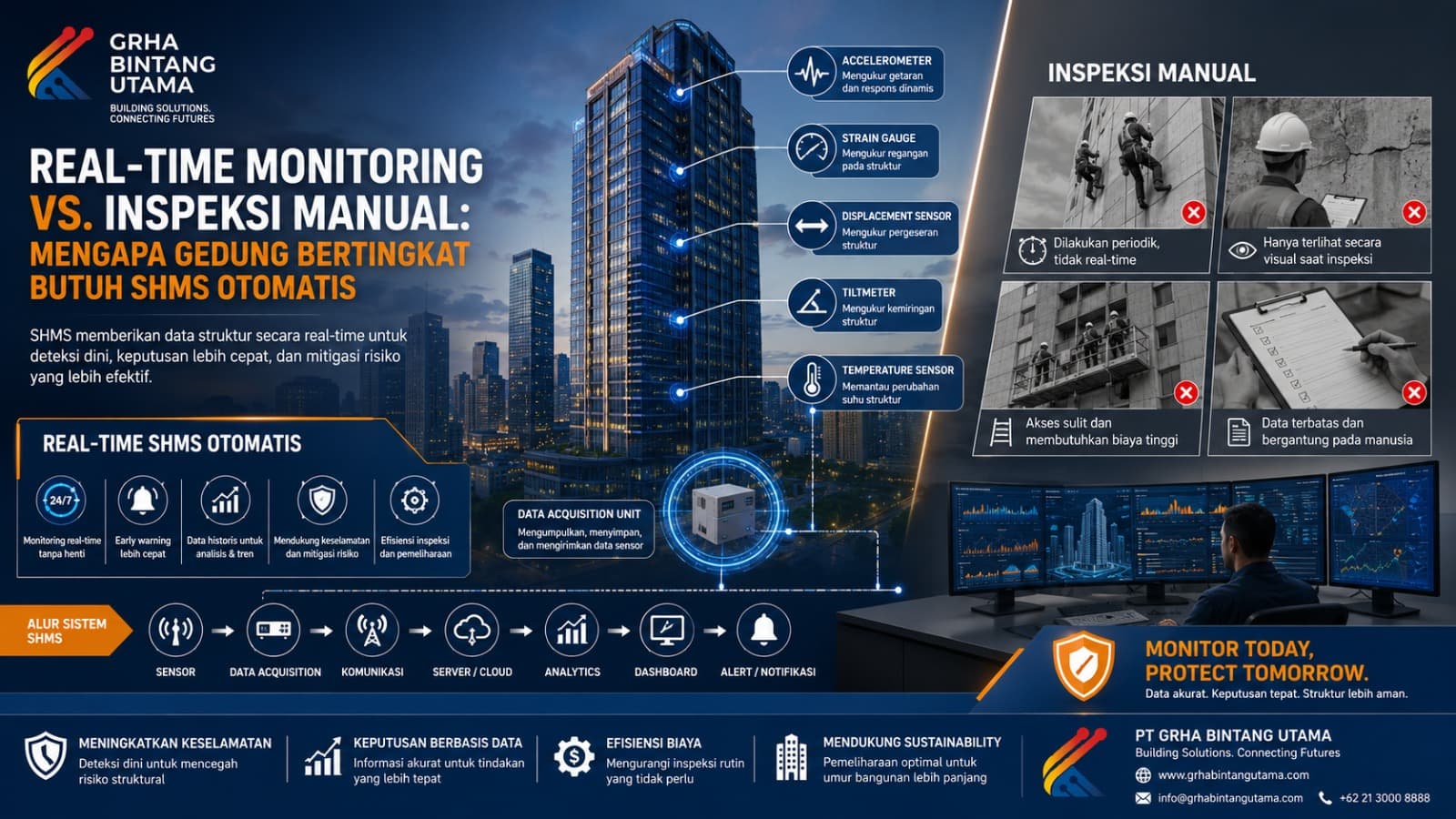
Real-Time Monitoring vs Manual Inspection: Why High-Rise Buildings Need Automated SHMS
Read More
The Importance of Digital Structural Audits for Infrastructure Over 20 Years Old
Read More
5 Critical Components of a Weighbridge That Require Regular Maintenance
Read More

Jakarta Selatan, [email protected] 0812-1146-0008